
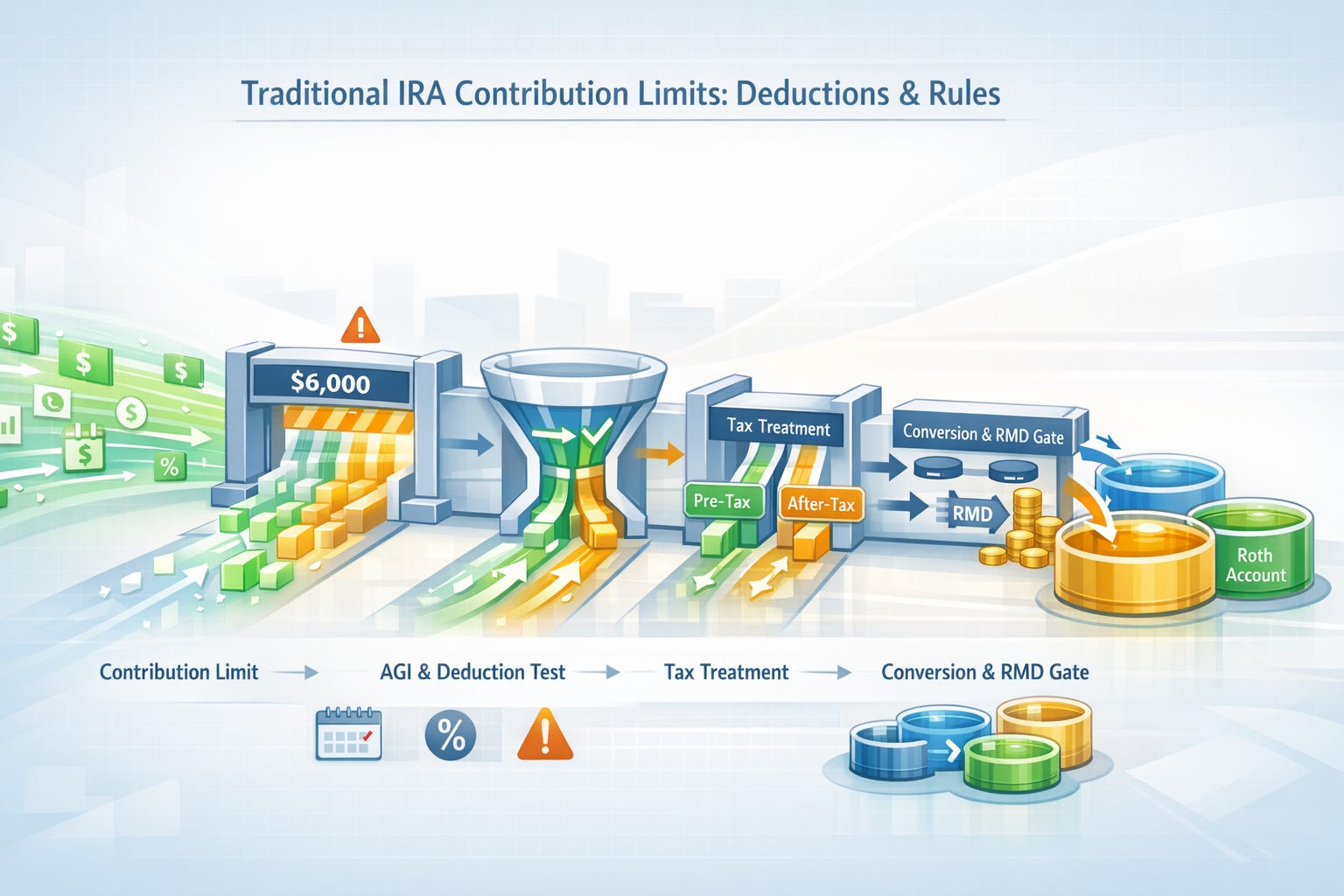
Traditional IRA Contribution Limits: Deductions & Rules
When it comes to retirement savings, the traditional IRA remains one of the most widely used options for Americans seeking tax-deferred growth. The IRS traditional IRA limits are updated regularly, shaping how much individuals can contribute, deduct, and eventually withdraw. It’s important to note that if you exceed the traditional IRA contribution limit, the IRS may impose a 6% excess contribution penalty tax for each year the excess remains in your account. Understanding these rules, along with the options for Roth IRA and traditional IRA conversions, ensures you maximize your retirement savings while avoiding penalty taxes.
This guide explains deductions, contribution limits, distribution rules, and conversions, enabling you to make informed decisions about your retirement plan account.
Traditional IRA Contribution Limits for 2025
For the 2025 calendar year, the annual contribution limit is $7,000, with an additional $1,000 catch-up allowance for individuals aged 50 or older. These amounts apply across all types of plans in the IRA family.
The IRS traditional IRA limits require that contributions cannot exceed your taxable income for the year. Contributions must be made by the end of the year (December 31, 2025). However, the IRS allows until the due date of the tax filing deadline in April 2026 to count contributions toward the 2025 tax year.
Deductibility and AGI Limits
One of the main benefits of a traditional IRA is the potential for a tax deduction. However, there are rules:
● If you or your spouse is covered by a retirement plan account such as a 401(k), your deduction phases out at certain income levels.
● The AGI limit for traditional IRA contributions determines whether you can claim a full deduction or only a partial one.
● For those without workplace coverage, contributions are generally fully deductible regardless of income.
In most cases, a traditional IRA deduction is applied in the same year the contribution is made. The deduction is then reported when filing the federal income tax return for that tax year.
After-Tax Contributions to a Traditional IRA
Not everyone qualifies for a deduction based on their gross income. In that case, you can still make after-tax contributions to a traditional IRA. While these contributions won’t lower your taxable income today, they still allow investment growth to be tax-deferred.
When distributions begin, the IRS requires you to track which part of your withdrawals is taxable versus which part is a return of after-tax contributions, as failure to manage these may lead to an excise tax. This adds complexity but also flexibility for savers with higher income levels.
Traditional IRA Distributions and Required Rules
Unlike Roth accounts, traditional IRA distributions must start by April 1 following the year you turn 73 (the current life expectancy rules apply under the SECURE Act 2.0). These withdrawals are known as Required Minimum Distributions (RMDs) for the original account owner.
Distributions are taxed at your ordinary income tax rate, adding to your taxable income for the year. Missing an RMD triggers an additional tax penalty, so planning is crucial.
Traditional IRA vs. Roth IRA Conversions
Many savers wonder about the best time for a traditional IRA to Roth IRA conversion. The IRS allows this strategy regardless of income, making it a popular option.
● A traditional IRA can be converted to a Roth IRA at any time, but the conversion must be completed by the end of the year to apply to that tax year.
● Converting a traditional IRA to a Roth IRA is often most advantageous when the current income tax rate is lower than expected future rates, or during periods when investments have temporarily declined in value.
● Converting a traditional IRA to a Roth means paying taxes now on the converted amount, but future withdrawals grow tax-free. There is no age limit for making traditional IRA contributions, but you must have earned income for the year to contribute. Keep in mind that your income tax and income tax rate may affect your overall IRA strategy.
● Converting a traditional IRA to a Roth means paying taxes now on the converted amount, but future withdrawals grow tax-free.
This process, often referred to as a Roth conversion, differs from contributing directly to a designated Roth account within a 401(k) or other qualified retirement plans.
Tools and Providers for Traditional IRAs
Several financial institutions offer IRAs, with popular choices such as a Vanguard traditional IRA. Many investors also use a traditional IRA calculator to determine contribution limits, tax savings, or to model the effects of various types of retirement plans, including a Roth IRA conversion.
These tools help evaluate whether the best traditional IRA for you is one with low-cost investments, broad fund choices, or specific features like seamless 401k to traditional IRA rollovers.
Roth and Traditional IRA Comparisons
When comparing a Roth and a traditional IRA, it’s essential to look at:
● Taxable income timing: A traditional IRA offers a deduction now, while a Roth IRA provides tax-free withdrawals later, making it beneficial for those in a higher tax bracket in the future.
● Eligibility requirements: Traditional IRA contributions are limited by the AGI limit for a traditional IRA, while Roth contributions phase out at different Roth IRA income levels.
● Distributions: Traditional IRAs require RMDs; Roth IRAs do not.
Ultimately, many savers split contributions between both to balance their tax exposure in retirement.
Conversions and Legal Authority
The IRS gives broad legal authority for IRA contributions and conversions. Still, there are additional restrictions:
● Contributions must be in cash (not property).
● You must have earned income (with exceptions for spousal IRAs).
● Additional information on reporting conversions is required on your tax return.
The amount of the conversion becomes part of your ordinary income tax in the year it occurs, potentially affecting tax credits and eligibility for deductions.
Practical Considerations
When planning around IRAs, always think about:
● The first day of the year counts toward contribution eligibility.
● Conversions and distributions, including your first RMD, must be completed by the end of the year to affect that tax year.
● Your filing status (single, married filing jointly, or separately) impacts eligibility.
● A calendar year approach keeps things aligned with IRS deadlines.
By aligning contributions and conversions with your individual situation, you can avoid excess contributions or penalties.
Example: Roth IRA Conversion from a Traditional IRA
Suppose you roll a 401k to a traditional IRA, then decide to complete a traditional IRA to Roth IRA conversion.
● The conversion must be reported on your federal income tax return.
● Your taxable income for that year increases by the converted amount.
● Depending on your income tax rate, you might owe more upfront but reduce your taxable withdrawals later.
This flexibility makes a Roth conversion attractive for long-term savers.
Conclusion
The traditional IRA remains a cornerstone of retirement planning, particularly when considering individual retirement arrangements. By understanding IRS traditional IRA limits, how deductions work, and when traditional IRA distributions must start, you can maximize your retirement savings.
Whether you’re considering after-tax contributions to a traditional IRA, a traditional IRA to Roth IRA conversion, or rolling over a 401k to a traditional IRA, the right strategy depends on your financial situation, income level, and the Roth IRA income limits, as well as long-term goals.
At RetireNova, we help clients navigate contribution rules, evaluate Roth and traditional IRA strategies, and avoid additional tax penalties. By providing tax advice and aligning your decisions with the end-of-the-year IRS deadlines and your life expectancy planning, you’ll ensure your retirement plan account is optimized for the future.
Contact us for more information.