

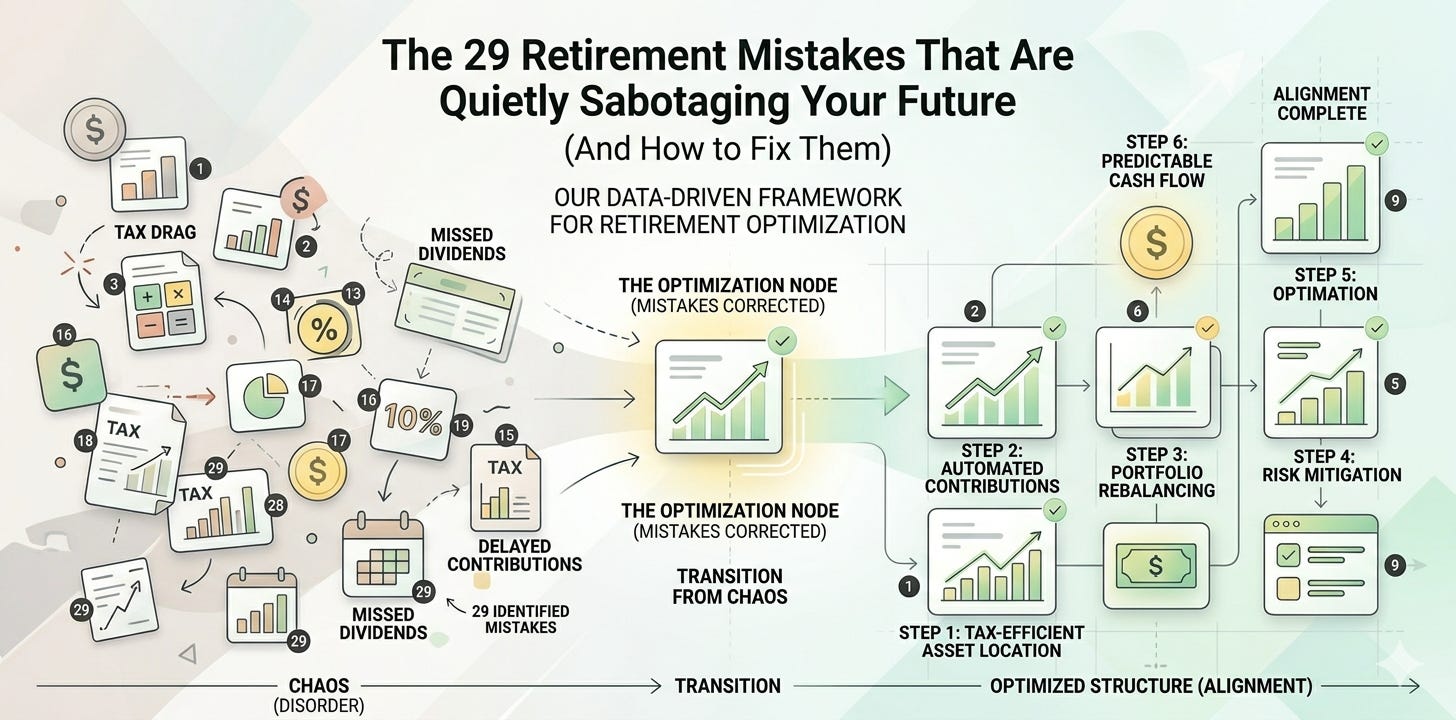
Let’s be honest: we all make financial mistakes. According to recent studies, at least half of Americans are making most of these errors right now. The good news? Once you know what they are, they’re surprisingly easy to fix.
I’m going to walk you through the 29 most common retirement planning mistakes I see—including the big three that trip up almost everyone (spoiler: #4, #8, and #26). More importantly, I’ll show you exactly how to correct them before they derail your retirement.
The Foundation Mistakes (These Are Killing Your Plan)
Mistake #1: Flying Blind Without a Budget
Only 41% of Americans use a budget. When you’re working and money’s coming in regularly, you might get away with mental accounting. But retirement? That’s a whole different game.
The Fix: Spend one hour this week tracking everything you spent last month. Categorize it. Then do it again next month. You need to know your real spending patterns—not what you think you spend, but what you actually spend. This becomes the foundation of your retirement budget.
Mistake #2: Living in Too Much House
The average American house has doubled in size since the 1950s. Between 2011 and 2014, more than half of Americans made major sacrifices just to cover their housing costs. And I’m not talking about skipping lattes—I’m talking about serious sacrifices.
The Fix: Housing is your biggest expense and probably your biggest asset. Model downsizing scenarios now. Even if you don’t plan to move for years, knowing the financial impact of selling and moving to a smaller place gives you options when you need them most.
Mistake #3: Not Having an Investment Strategy
Flying by the seat of your pants with your investments is a recipe for panic-selling at the worst possible times.
The Fix: Create an Investment Policy Statement (IPS). It sounds fancy, but it’s just a written plan that defines your investment goals, your strategy for achieving them, and what you’ll do when markets get crazy. Think of it as your financial constitution—it keeps you from making emotional decisions with your retirement money.
The Timing Mistakes (Cost You Hundreds of Thousands)
Mistake #4: Starting Your Planning Too Late
This is the one almost everyone gets wrong. Putting money into a 401(k) is great, but how do you know if you’re saving enough? Most people don’t run the numbers until they’re a few years from retirement. By then, your options are limited.
The Fix: Run a comprehensive retirement projection right now, regardless of your age. If you’re 30, great —you have time to adjust. If you’re 55, you need to know today if you’re on track or need to make
changes. Waiting doesn’t make the math better.
Mistake #5: Claiming Social Security at the Wrong Time
The difference between claiming at 62 and waiting until 70 can literally mean $300,000+ in lifetime benefits for some people. Yet most people claim early without running the numbers.
The Fix: Model at least three scenarios: claiming at 62, at your Full Retirement Age, and at 70. Factor in your other income sources, your health, and your family longevity. This isn’t a decision to make based on what your neighbor did.
Mistake #6: Retiring With Debt Still Hanging Over You
Carrying a mortgage or other significant debt into retirement means you need substantially more income every month just to stay afloat.
The Fix: Make debt elimination part of your pre-retirement timeline. If you can’t fully pay off your mortgage, at least have a clear plan and ensure your retirement income can handle the payments. Or consider downsizing to eliminate the debt entirely.
The Money Management Mistakes (Drain Your Accounts)
Mistake #7: Ignoring Required Minimum Distributions (RMDs)
Once you hit 73 (as of 2023, thanks to SECURE 2.0), the IRS forces you to withdraw money from your traditional retirement accounts. Miss it? The penalty is brutal—up to 25% of what you should have withdrawn.
The Fix: Understand your RMD schedule years before you need to take them. Better yet, consider Roth conversions in your 60s when you might be in a lower tax bracket. This reduces future RMDs and gives you more control.
Mistake #8: Having No Tax Strategy
Most people obsess over investment returns but completely ignore the tax implications of their retirement income. Big mistake. The IRS doesn’t care about your pre-tax account balance—they want their cut when you withdraw.
The Fix: Understand the tax character of your different accounts (taxable, tax-deferred, tax-free). Plan your withdrawal sequence strategically. Consider where you live—12 states still tax Social Security benefits. A good tax strategy can save you tens of thousands over retirement.
Mistake #9: Withdrawing Too Much, Too Soon
Just because you can access your retirement accounts doesn’t mean you should drain them. The old 4% withdrawal rule is under scrutiny in today’s low-rate environment, but taking out 7-8% annually? You’re asking for trouble.
The Fix: Build a realistic spending plan with different phases. Most retirees spend more in early retirement (the “go-go years”), less in mid-retirement (the “slow-go years”), and more again in late retirement for healthcare (the “no-go years”). Plan accordingly.
Mistake #10: Being Too Conservative (Or Too Aggressive)
Fear of losing money makes some retirees park everything in cash or CDs. But over 20-30 years, inflation will destroy your purchasing power. On the flip side, being 100% in stocks at 70 is equally dangerous.
The Fix: Your investment allocation should match your timeline and risk tolerance. You need growth to outpace inflation, but you also need stability for near-term expenses. That’s why bucket strategies work— safe money for the next 3-5 years, balanced money for years 5-10, growth money for 10+.
The Planning Process Mistakes (Leave You Vulnerable)
Mistake #11: Planning Once and Never Updating
Markets change. Life changes. Your plan needs to change too. Meeting with an advisor once or running an online calculator and calling it done? That’s not planning—that’s wishful thinking.
The Fix: Review and update your plan every 3-6 months minimum. Major life changes (health issues, market crashes, family situations) should trigger immediate plan reviews. Your retirement plan is a living document, not something you frame and forget.
Mistake #12: Not Stress-Testing Your Plan
Planning for average returns and average expenses is fine until reality hits. What happens if the market drops 30% in your first year of retirement? What if healthcare costs spike? What if you live to 95 instead of 85?
The Fix: Run pessimistic scenarios. Model a 2008-style crash happening right when you retire. See what happens if you live 10 years longer than expected. If your plan falls apart in these scenarios, you need more cushion or a different strategy.
Mistake #13: Forgetting About Healthcare Costs
Medicare isn’t free, and it doesn’t cover everything. The average 65-year-old couple will spend over $300,000 on healthcare in retirement. That’s not including long-term care.
The Fix: Budget specifically for Medicare premiums, supplemental insurance, prescription costs, and out-of-pocket expenses. If you retire before 65, have a real plan for health insurance—it’s expensive. And address long-term care either through insurance, self-funding, or hybrid strategies.
The Lifestyle and Legacy Mistakes
Mistake #14: Not Planning for Different Spending Phases
Assuming you’ll spend the exact same amount every year for 30 years? That’s not how retirement actually works.
The Fix: Build different spending levels into different phases. Budget more for travel and activities in your 60s and early 70s when you’re most active. Recognize spending typically decreases in your mid-70s and 80s, then potentially spikes again for healthcare in your 80s and beyond.
Mistake #15: Sacrificing Your Life to Leave an Inheritance
Living like a pauper because you want to leave $500K to your kids isn’t noble—it’s sad. You worked your whole life for this money.
The Fix: Have honest conversations with your family about expectations. If leaving a legacy is important, build it into your plan deliberately. But don’t sacrifice your retirement quality of life without discussing it with the people you’re trying to help.
Mistake #16: Not Coordinating with Your Spouse
Making retirement decisions in isolation when you’re married is a recipe for conflict and suboptimal outcomes. Your Social Security claiming strategies should work together. Your spending plans need to align.
The Fix: Make retirement planning a team sport. Run scenarios together. Discuss what matters to each of you. Coordinate Social Security timing, investment strategies, and long-term goals. When one spouse dies, the survivor’s situation changes dramatically—plan for that now.
The Insurance and Protection Mistakes
Mistake #17: Being Under-Insured (Or Over-Insured)
Not having adequate life insurance when you need it, or keeping expensive policies you no longer need, both cost you money.
The Fix: Reassess insurance needs every few years. As you age and accumulate assets, life insurance becomes less critical. But if your spouse depends on your income or your pension dies with you, you need coverage. Drop what you don’t need; keep what you do.
Mistake #18: Ignoring Long-Term Care Planning
One in two people will need some form of long-term care. At $100,000+ per year for a nursing home, this can devastate even substantial nest eggs.
The Fix: Address this in your 50s or early 60s. Options include traditional long-term care insurance, hybrid life/LTC policies, self-funding if you have substantial assets, or Medicaid planning if appropriate. Not deciding is still a decision—and usually the worst one.
Mistake #19: No Estate Planning Documents
Dying without a will, trust, power of attorney, and healthcare directive leaves your family with a mess and the courts in control of your wishes.
The Fix: Get the basic documents done. At minimum: will, durable power of attorney, healthcare power of attorney, and living will. If you have significant assets or complex family situations, consider trusts. Update these when major life changes occur.
The Income Optimization Mistakes
Mistake #20: Not Maximizing Employer Benefits
Not taking full advantage of employer 401(k) matches is literally turning down free money. Same with HSAs if you’re eligible.
The Fix: At minimum, contribute enough to get the full employer match. If you can, max out your 401(k) ($23,000 in 2024, plus $7,500 catch-up if you’re 50+). Max out your HSA if eligible ($4,150 individual, $8,300 family for 2024, plus $1,000 catch-up at 55+). These are the most powerful wealth-building tools available.
Mistake #21: Missing Roth Conversion Opportunities
The years between retirement and RMDs starting (typically 65-73) are often golden years for Roth conversions—especially if you’re not yet taking Social Security.
The Fix: Model Roth conversion strategies. Converting traditional IRA money to Roth in lower-income years can save massive taxes later and reduce future RMDs. Yes, you pay tax now, but you’re paying it at a lower rate and gaining tax-free growth forever.
Mistake #22: Not Considering Geographic Arbitrage
Living in a high-tax, high-cost-of-living state in retirement can cost you hundreds of thousands over 20- 30 years compared to a more tax-friendly location.
The Fix: Research state tax treatment of retirement income, Social Security, pensions, and property taxes. Some states like Florida, Texas, and Nevada have no state income tax. Others tax everything. Even if you don’t want to move, knowing the numbers gives you options.
The Psychological and Behavioral Mistakes
Mistake #23: Letting Fear Drive Decisions
Panic-selling during market downturns, refusing to retire because you’re scared of running out of money despite having $2 million, or claiming Social Security early “just in case” are all fear-based decisions that usually backfire.
The Fix: Make decisions based on data and planning, not emotion. When you feel fear creeping in, that’s the signal to run the numbers again, not to make a rash decision. A good plan gives you confidence; constant worry suggests you need a better plan.
Mistake #24: Comparing Yourself to Others
Your neighbors might have a nicer car and take more vacations, but you don’t know their financial situation. They might be drowning in debt or burning through an inheritance.
The Fix: Focus on your own plan and your own goals. Financial peace comes from knowing your numbers and living within your means, not from keeping up with the Joneses.
Mistake #25: Not Planning for Purpose Beyond Money
Retiring without a plan for how you’ll spend your time and find meaning leads to depression, health problems, and ironically, overspending out of boredom.
The Fix: Start thinking about your purpose in retirement years before you retire. What will give you meaning? How will you stay engaged? What relationships will you nurture? The most successful retirees retire TO something, not FROM something.
The Final Critical Mistakes
Mistake #26: Assuming You Can Work Forever
“I’ll just work longer if I need to” sounds great until health issues, job loss, or caregiving responsibilities make it impossible. The average actual retirement age is 62, regardless of when people plan to retire.
The Fix: Build your plan assuming you might have to retire earlier than planned. If you can work longer, great—you’re ahead of schedule. But if you can’t, you’re not scrambling. This is one of the most important margin-of-safety factors in retirement planning.
Mistake #27: Not Understanding Sequence of Returns Risk
Two people can earn the same average return but have wildly different outcomes based on when those returns happen. Negative returns in early retirement are devastating, even if the market recovers later.
The Fix: Protect yourself with proper asset allocation and bucket strategies. Keep several years of expenses in stable investments so you’re not forced to sell stocks in a down market. This is more important than your average return.
Mistake #28: Forgetting About Inflation
Planning in today’s dollars without accounting for inflation means your plan becomes less realistic every year. At 3% inflation, prices double every 24 years.
The Fix: Always run projections that include inflation (typically 2.5-3%). Understand that your income needs will increase over time. This is why Social Security’s COLA adjustments are so valuable—it’s inflation-protected income.
Mistake #29: Trying to Do Everything Yourself Without Professional Help I’m a big believer in financial education and being involved in your planning. But completely DIY-ing complex retirement planning without any professional guidance? That’s often a costly mistake.
The Fix: Hire a fiduciary financial advisor for at least a comprehensive review every few years, even if you manage your own investments day-to-day. A second set of expert eyes can catch mistakes, spot opportunities, and give you confidence you’re on track. The cost is minimal compared to the value of getting it right.
Your Action Plan: Fix These Mistakes Now
This Week:
Calculate your actual monthly spending for the last 90 days (mistake #1)
Check if you’re getting full employer match on 401(k) (mistake #20)
Verify you have basic estate documents—will, POA, healthcare directive (mistake #19) Review your current insurance coverage (mistake #17)
This Month:
Run a comprehensive retirement projection with your actual numbers (mistake #4) Create or update your Investment Policy Statement (mistake #3)
Model Social Security claiming strategies for you and your spouse (mistake #5) Calculate your debt payoff timeline and align it with retirement date (mistake #6) Stress-test your plan with pessimistic scenarios (mistake #12)
This Quarter:
Research tax-friendly states if relocation is possible (mistake #22)
Model Roth conversion opportunities (mistake #21)
Project healthcare costs and gap coverage before Medicare (mistake #13)
Evaluate long-term care planning options (mistake #18)
Build spending phases into your plan—go-go, slow-go, no-go years (mistake #14)
This Year:
Schedule a comprehensive review with a fiduciary financial advisor (mistake #29) Create a purpose plan—what will give you meaning in retirement? (mistake #25) Review and update your plan quarterly (mistake #11)
Have honest money conversations with your spouse and adult children (mistakes #15 & #16) Set up automatic plan reviews every 3-6 months going forward (mistake #11)
Before You Retire:
Calculate exact RMD timeline and tax implications (mistake #7)
Finalize withdrawal sequence strategy across all account types (mistake #8)
Ensure debt elimination or sustainable debt service plan is in place (mistake #6) Build 2-3 years of conservative assets before retirement for sequence risk protection (mistake #27) Consider one final comprehensive plan review (mistake #29)
Frequently Asked Questions
Q: I’m already making several of these mistakes. Is it too late to fix them?
It’s never too late, but earlier is always better. If you’re 45 and just starting, you have 20+ years to correct course. If you’re 65 and retired, you can still make adjustments—you might just need to be more creative. The key is starting now, not waiting until tomorrow.
Q: Should I really update my plan every 3-6 months? That seems excessive.
Think of it like going to the dentist—a little preventive maintenance prevents big problems. You don’t need to spend hours on it. A quarterly 30-minute check-in to update account balances, confirm assumptions still hold, and adjust if needed is plenty. When major life changes happen (health issues, market crashes, inheritance), you do a deeper dive.
Q: What’s the difference between mistakes that cost thousands versus hundreds of thousands?
The timing mistakes (#4, #5, #6) and tax mistakes (#7, #8, #21) tend to have the biggest dollar impact because they compound over decades. A Social Security claiming mistake might cost $300K. Poor tax planning might cost $200K in excess taxes over retirement. The lifestyle mistakes (#1, #2) impact your quality of life and can cost $50-100K. All are worth fixing, but prioritize the six-figure mistakes.
Q: I’m scared to look at my numbers because I think I’m way behind. What should I do?
Ignorance isn’t bliss—it’s just delayed panic. Knowing where you stand, even if it’s not where you want to be, gives you options and time to adjust. You might need to work a few more years, reduce expenses, relocate, or adjust expectations. But all of those options are better than retiring with your eyes closed and running out of money at 75. Run the numbers this week.
Q: My employer doesn’t offer a 401(k) match. Should I still contribute?
Absolutely. The tax deduction now plus decades of tax-deferred growth is still powerful even without a match. If your employer offers a 401(k) at all, contribute at least enough to get meaningful tax savings. If you’re high-income and maxing it out, even better. If no 401(k) is available, use an IRA (traditional or Roth depending on your income and tax situation).
Q: What’s the biggest mistake you see high-income professionals make?
Surprisingly, mistake #4 (starting planning too late) even though they’re successful in their careers. They assume because they’re making good money and maxing out their 401(k), they’re automatically on track. Then at 58 they run the numbers and realize they need to work until 70, or they need to cut spending dramatically. Having a high income doesn’t automatically equal good retirement planning.
Q: How much should I really plan to spend in retirement compared to my working years?
The old “80% of pre-retirement income” rule is too simplistic. Some expenses drop (commuting, work clothes, payroll taxes, retirement savings). But others increase (healthcare, travel if you’re living the retirement you want). I see everything from 60% to 120% of pre-retirement spending. Run your actual expected expenses, not a percentage.
Q: Is the 4% withdrawal rule dead?
Not dead, but it needs context. It was based on historical data and a 50/50 stock/bond allocation. In today’s environment, some argue for 3-3.5% to be safer. Others say it’s fine if you’re flexible and will reduce spending in down markets. The real answer: use it as a starting point, not gospel. Build flexibility into your plan and adjust based on actual market returns.
Q: Should I pay off my mortgage or invest the money instead?
This is math versus emotion. Mathematically, if your mortgage rate is 3% and you can earn 8% in the market, you should invest. Emotionally, being debt-free in retirement provides peace of mind and reduces required income. I lean toward eliminating the mortgage before retirement if possible, especially if you’re within 5 years of retiring. The guaranteed “return” of eliminating the payment is worth something.
Q: What’s one thing I can do TODAY that will have the biggest impact?
Calculate your actual monthly spending over the last 90 days. Right now. This single number—what you really spend, not what you think you spend—is the foundation of every single calculation in your retirement plan. Get this wrong and everything else is built on sand. Get this right and you can make informed decisions about everything else.
Look, nobody gets all 29 of these right on the first try. I’ve been doing this for years and I still catch myself making some of these mistakes in my own planning. The goal isn’t perfection—it’s progress.
Pick three mistakes from this list that you know you’re making. Fix those this month. Then pick three more next month. Within a year, you’ll have addressed the majority of these issues and you’ll be in a completely different position.
The difference between a mediocre retirement and a confident, secure retirement often comes down to fixing these mistakes before they compound into bigger problems. You’ve got this—now go do it.
Ready to see where your plan stands? Let’s run your numbers and build a real strategy that addresses these mistakes specifically for your situation.