
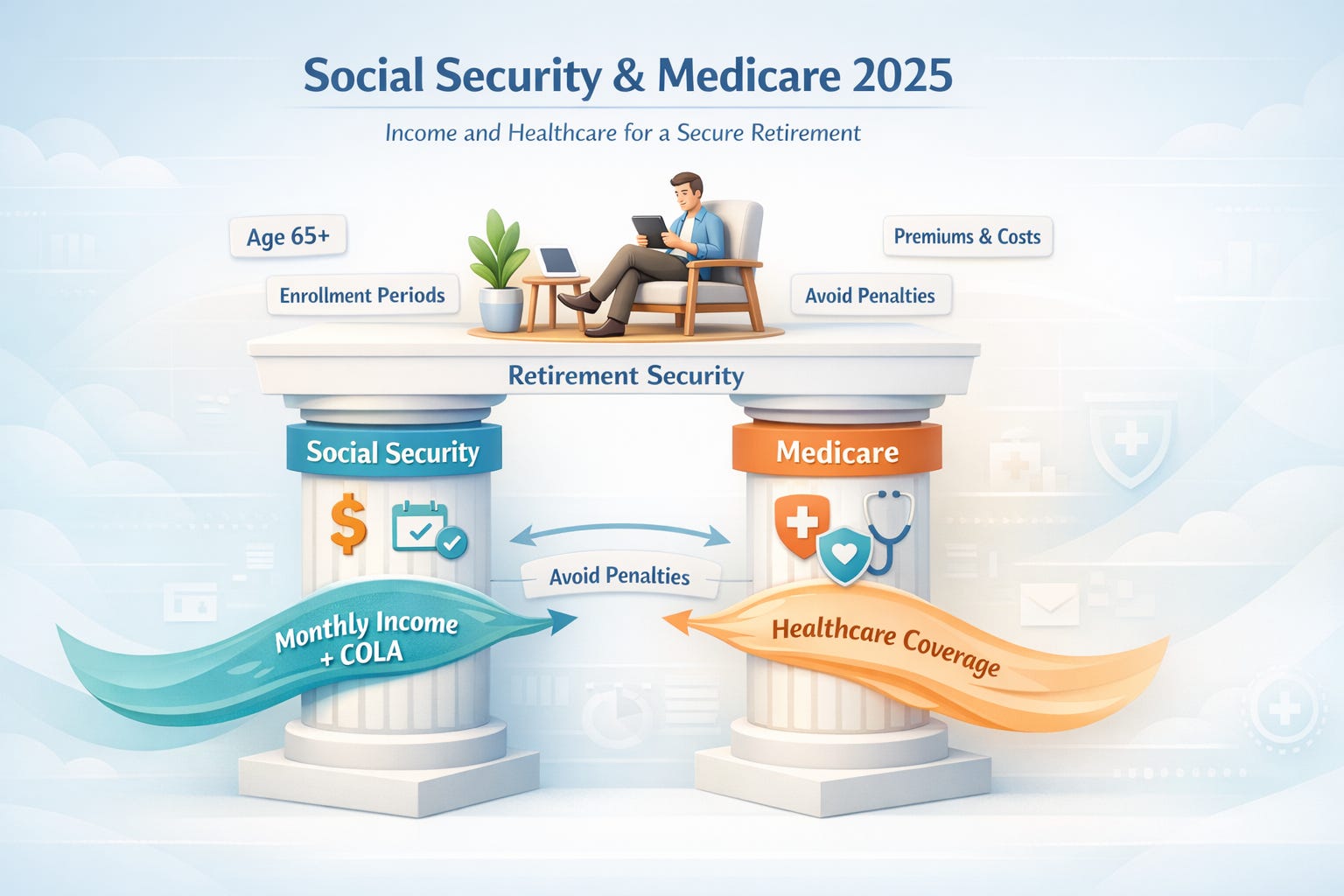
For most Americans, retirement security rests on two main pillars: Social Security for monthly income and Medicare for health coverage. Together, they form the foundation of financial stability later in life. But while they’re connected, they don’t operate the same way.
Social Security provides income you’ve earned over your working years. Medicare, on the other hand, helps cover your healthcare costs once you reach 65. You can receive one without the other, but understanding how they interact and how their rules change each year is key to making smart decisions.
As we head into 2025, retirees can expect a few important updates:
● Cost-of-Living Adjustments (COLA): modest increases to Social Security benefits to keep up with inflation.
● Medicare Premium Changes: slight adjustments to Part B and Part D costs.
● Enrollment Rules: updated timeframes and penalties that affect when coverage begins.
At RetireNova, our goal is to make these complex systems easy to understand. We help retirees turn rules into clear plans so you can maximise benefits, avoid penalties, and stay confident about your financial future.
Social Security in 2025: Key Updates Retirees Should Know
Every year, the Social Security Administration (SSA) adjusts benefits to reflect the changing economy. For 2025, retirees can expect moderate updates designed to maintain purchasing power and stability.
Here’s what to keep in mind:
● Cost-of-Living Adjustment (COLA): Social Security payments will see a modest increase in 2025, keeping up with inflation. While not a dramatic change, this ensures your income maintains its real-world value as everyday costs rise.
● Full Retirement Age (FRA): For those born in 1959 or 1960, the full retirement age is now 67. Retiring earlier means smaller monthly checks, while delaying past FRA can boost your benefit by up to 8% per year until age 70.
● Payment Schedule: Your benefit payment date depends on your birth date, a small but important detail for monthly budgeting and cash flow planning.
● Disability and Supplemental Programs: Individuals receiving Social Security Disability Insurance (SSDI) or Supplemental Security Income (SSI) may also see updated thresholds and benefits. After 24 months of disability entitlement, many SSDI recipients automatically qualify for Medicare coverage..
Medicare Costs in 2025: What’s Changing and What It Means
Healthcare is one of the biggest concerns for retirees, and that’s where Medicare comes in. But like Social Security, it’s updated every year, and knowing the changes helps you budget accurately.
Here’s what to expect in 2025:
● Medicare Part A (Hospital Insurance): Most retirees qualify for free Part A if they or their spouse worked and paid into Social Security for at least 40 quarters. However, the hospital deductible what you pay before coverage kicks in, will rise slightly next year.
● Medicare Part B (Medical Insurance): Part B requires a monthly premium. In 2025, premiums will see a modest increase, especially for higher-income earners who pay more through IRMAA (Income-Related Monthly Adjustment Amount).
● Medicare Part D (Prescription Drug Coverage): Private insurers manage these plans, but the government sets rules. In 2025, a new out-of-pocket spending cap will help protect retirees from runaway prescription costs, one of the most welcome changes this year.
Important reminder:
Delaying enrollment in Part B or Part D without qualified coverage can result in a permanent penalty, something many retirees don’t realise until it’s too late.
Medicare can feel complicated, but with the right plan and timing, it can also be one of your greatest retirement safeguards. RetireNova helps you understand these moving parts and create a healthcare strategy that fits your budget and lifestyle.
Enrollment Periods You Must Know in 2025
Enrolling in Medicare isn’t a one-time event; it’s about timing. Knowing when to sign up can save you thousands in penalties and ensure your coverage starts exactly when you need it.
Here are the four key enrollment windows every retiree should know:
● Initial Enrollment Period (IEP): This is your first chance to sign up for Medicare. It’s a seven-month window starting three months before your 65th birthday, including your birth month, and ending three months after. Sign up during this time to avoid delays or late penalties.
● General Enrollment Period (GEP): If you miss your IEP, you can sign up between January 1 and March 31 each year. Your coverage will begin in July, but be aware that late enrollment may lead to permanently higher premiums.
● Special Enrollment Period (SEP): If you’re still working (or your spouse is) and covered by a group health plan, you can delay enrolling without a penalty. Once that coverage ends, you’ll have eight months to sign up under SEP rules.
● Open Enrollment Period (OEP): Every year from October 15 to December 7, retirees can review their coverage, switch between Original Medicare and Medicare Advantage, or adjust their Part D prescription plan.
At RetireNova, we help retirees understand which enrollment period applies to them and how to coordinate Medicare with existing employer or retirement coverage.
Medicare Advantage and Prescription Drug Coverage in 2025
Medicare continues to evolve, and one of the biggest shifts in recent years has been the rise of Medicare Advantage (Part C) plans. These plans bundle hospital, medical, and often prescription drug coverage into one easy-to-manage package, a convenient option for many retirees.
Here’s what to know for 2025:
● All-in-One Coverage: Medicare Advantage combines Parts A and B, and usually Part D for prescription drugs. Many plans also include extra perks like dental, vision, hearing, or even gym memberships.
● Prescription Drug Protections: In 2025, new federal rules will cap annual out-of-pocket spending on prescriptions, helping retirees better manage drug costs, a major win for those with chronic conditions.
● Medicare Advantage Growth: These plans now serve nearly half of all Medicare beneficiaries nationwide. Large retiree groups, including NYC public retirees, have sparked national discussions about coverage quality, flexibility, and cost-sharing.
Choosing between Original Medicare and Advantage plans often comes down to flexibility versus convenience. RetireNova helps clients compare both options and find a plan that fits their health needs and travel or provider preferences.
Social Security and Medicare Eligibility Rules
Eligibility for Social Security and Medicare is based on a mix of age, work history, and disability status, and understanding these requirements can help you plan the timing of your applications.
Here’s what matters most:
● Age 65: Most Americans become eligible for Medicare at 65, whether or not they’ve started collecting Social Security benefits.
● Work Credits: To qualify for free Medicare Part A, you or your spouse must have earned 40 quarters (about 10 years) of work credits under Social Security. If you have fewer credits, you may still qualify by paying a premium.
● Disability Eligibility: Those receiving Social Security Disability Insurance (SSDI) become eligible for Medicare after 24 months of benefits. However, individuals with certain serious conditions, such as ALS (Lou Gehrig’s disease) or End-Stage Renal Disease (ESRD), qualify much faster.
These rules highlight an important truth: Medicare isn’t automatic, and it isn’t always free. Applying early and confirming your eligibility can prevent costly delays or unexpected coverage gaps later on.
How Social Security and Medicare Work Together?
Social Security and Medicare are two separate programs, but they often overlap, especially when it comes to enrollment and benefits. Understanding how they connect can help you avoid duplicate paperwork, missed coverage, or unnecessary confusion.
Here’s how they work together in practice:
● Automatic Enrollment: When you apply for Social Security retirement benefits, you’re typically automatically enrolled in Medicare Parts A and B. This helps ensure your healthcare coverage starts when your benefits do.
● Medicare-Only Option: Not ready to collect Social Security yet? You can apply for Medicare-only through the Social Security Administration (SSA) without affecting your retirement income.
● Online Account Management: The SSA website allows you to log in anytime to check your benefit status, track Medicare enrollment, and even schedule or manage appointments.
● Coordination of Benefits: If you’re still working and have employer-provided health coverage, Medicare, and your group plan will coordinate to determine which pays first. Knowing these rules ensures you don’t pay more than necessary.
These connections make retirement planning smoother, but they also mean you’ll want to keep your Social Security information up to date. RetireNova helps retirees streamline these details so that income and healthcare plans align without the paperwork headache.
Costs, Penalties, and Taxes to Watch in 2025
Retirement benefits are designed to support you, but they come with financial responsibilities too. Knowing where potential costs and penalties can appear helps you protect your income and avoid unpleasant surprises.
Here’s what to keep in mind for 2025:
● Payroll Taxes: While you’re working, both you and your employer contribute 7.65% of your income toward Social Security and Medicare, 6.2% for Social Security and 1.45% for Medicare.
● IRMAA Surcharges: Retirees with higher incomes will pay more for Medicare Part B and Part D premiums under the Income-Related Monthly Adjustment Amount (IRMAA). These surcharges are recalculated yearly, based on your most recent tax return.
● Late Enrollment Penalties: Missing your initial enrollment for Part B or Part D can result in a permanent premium increase, meaning you’ll pay more every month for the rest of your life.
DIY Checklist: Prepare for Social Security and Medicare in 2025
Keeping track of all the moving parts doesn’t have to be complicated. Here’s a quick, five-step checklist to help you stay organised, avoid penalties, and make the most of your benefits in 2025:
1. Review Key Dates for Eligibility and Enrollment. Check when you turn 65 and confirm your Social Security Full Retirement Age (FRA) is now 67 for those born in 1960 or later.
2. Mark Your Enrollment Windows. Note your Initial Enrollment Period (IEP) around your 65th birthday, and remember Open Enrollment (Oct 15–Dec 7) for plan changes.
3. Review Expected 2025 COLA and Premium Updates. COLA adjustments and Medicare premium changes affect your income and expenses plan accordingly to keep your budget balanced.
4. Avoid Penalties by Enrolling on Time.
Sign up for Parts B and D before your deadline to prevent lifetime surcharges. Double-check your Social Security record for accuracy before applying.
5. Coordinate Benefits if You’re Still Working. If you have employer coverage, confirm how it interacts with Medicare and Social Security so you don’t overpay or lose benefits.
A few hours of preparation today can protect your finances for years to come.
Enter 2025 Informed and Confident
Planning for retirement doesn’t stop once you’ve claimed your benefits; it’s an ongoing process of staying informed, adjusting when needed, and making confident choices.
As we move into 2025, a few key updates will shape how retirees manage both income and healthcare:
● COLA increases to Social Security that protects purchasing power against inflation.
● Medicare premium updates and new out-of-pocket caps that affect your monthly budget.
● Enrollment period reminders that help you avoid penalties and keep coverage uninterrupted.
The more you understand these details, the more control you have over your financial future. A little preparation goes a long way in protecting both your income and your peace of mind.
At RetireNova, our mission is to make retirement planning simpler, from Social Security timing to Medicare enrollment and beyond. Our advisors help you connect the dots, avoid costly mistakes, and create a plan that supports your lifestyle and long-term goals.
Staying informed isn’t just about following rules; it’s about staying confident in every decision you make.
FAQs
A. Enrollment & Eligibility FAQs
1. When should I apply for Social Security and Medicare together?
Most people apply for both at age 65, but if you’re still working and have employer health coverage, you may choose to delay Medicare without penalties.
2. Can I get Medicare without claiming Social Security benefits?
Yes. You can apply for Medicare-only through the Social Security Administration if you want coverage but prefer to delay your retirement income.
3. Do disability benefits automatically qualify me for Medicare?
Yes. If you receive Social Security Disability Insurance (SSDI), you generally qualify for Medicare after a 24-month waiting period, though certain conditions like ALS or ESRD allow faster access.
B. Coverage & Cost FAQs
4. How do Medicare Advantage and Original Medicare compare in 2025?
Original Medicare offers nationwide coverage and flexibility to see any provider. Medicare Advantage (Part C) combines Parts A, B, and often D into one plan, with extra benefits like vision or dental, but typically uses a local network of doctors.
5. What are the new Medicare Part B and Part D costs?
Part B premiums are expected to rise slightly in 2025, with higher-income retirees paying more under IRMAA rules. Part D drug plans will also introduce out-of-pocket spending caps to help control prescription costs.
6. What happens if I delay Medicare enrollment?
If you miss your initial enrollment period and don’t have other qualifying coverage, you could face permanent late-enrollment penalties, higher monthly premiums for life.
C. Planning & Coordination FAQs
7. How do Medicare and Social Security work together?
The Social Security Administration handles Medicare enrollment and payments. When you start collecting Social Security, you’re usually auto-enrolled in Medicare Parts A and B, and premiums are often deducted directly from your benefit check.
8. How can I avoid penalties and optimise my retirement plan?
Mark key dates early, review your benefits annually, and coordinate your Social Security claiming strategy with Medicare enrollment. Working with RetireNova’s advisors helps ensure you stay compliant and make the most of your retirement income.