
If you’re self-employed, saving for retirement often feels like a solo mission. Without access to an employer-sponsored 401(k) or matching contributions, you’re responsible for creating your own plan, one that balances flexibility, high contribution potential, and long-term growth.
That’s where a SEP IRA comes in.
A Simplified Employee Pension (SEP) IRA is designed for business owners, freelancers, and independent contractors who want to build serious retirement savings without the red tape of a traditional corporate plan.
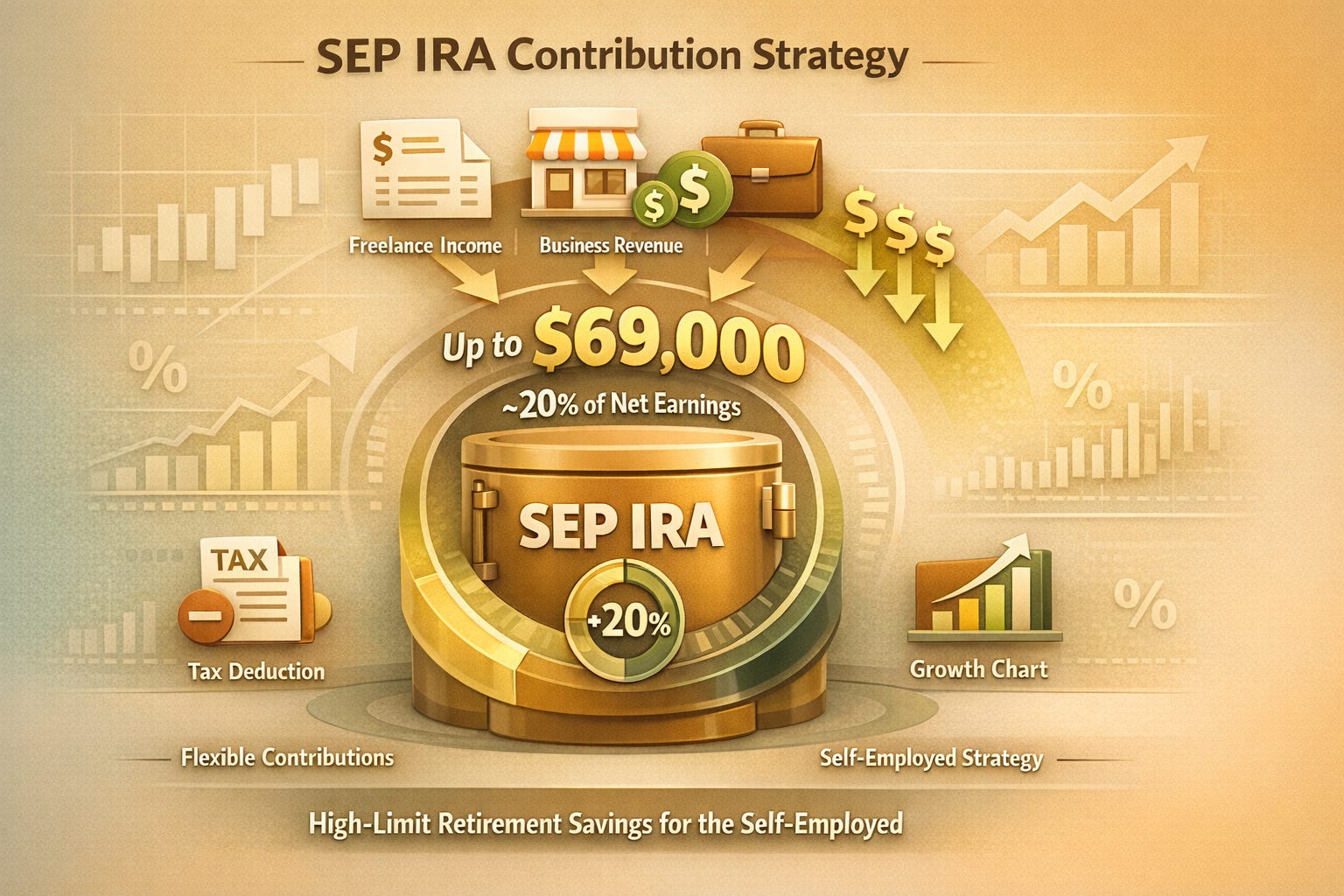
For 2025, the SEP IRA remains one of the most powerful tools for self-employed individuals, offering contribution limits up to $69,000, tax-deductible contributions, and the freedom to contribute on your own schedule. Whether your income fluctuates or you’re building a growing business, this plan gives you both structure and flexibility.
Let’s start with the basics, what exactly is a SEP IRA, and how does it work?
What is a SEP IRA?
A SEP IRA, short for Simplified Employee Pension Individual Retirement Account — is a retirement plan that helps small business owners and self-employed professionals save for the future while enjoying meaningful tax breaks today.
Here’s why it’s such a popular choice among entrepreneurs:
● Simple to set up: There’s no complex paperwork or annual filing requirements. Most plans can be opened at a bank or brokerage with minimal effort.
● Tax advantages: Contributions are tax-deductible as a business expense and grow tax-deferred until retirement.
● Flexible funding: You can decide each year how much to contribute based on your profits, or skip contributions entirely in slower years.
If you want to review the IRS rules yourself, the official “Simplified Employee Pension” guidance on the IRS website covers eligibility, contribution formulas, and required forms. RetireNova’s guide simplifies that information, helping you apply those rules to your business with confidence.
Now that you know what a SEP IRA is, let’s talk about how much you can actually contribute in 2025.
2025 SEP IRA Contribution Limits
Each year, the IRS updates contribution limits for retirement plans, and 2025 offers self-employed professionals one of the most generous caps yet.
Here’s how it works:
● You can contribute up to 25% of your compensation, based on eligible earnings up to $345,000.
● The maximum annual contribution is $69,000.
● For sole proprietors or freelancers, the effective contribution rate typically equals about 20% of net earnings, once you factor in self-employment taxes and deductions.
Your business structure also affects how you calculate those contributions, here’s how that works.
How SEP IRA Contributions Work by Business Type?
How much you can contribute to a SEP IRA depends on how your business is structured. The IRS treats sole proprietors and S-corporation owners differently, so understanding which rules apply to you is key to maximising your savings.
A. If You’re Self-Employed or a Sole Proprietor
For freelancers, consultants, and other sole proprietors, your SEP IRA contribution is based on your net self-employment income, not gross revenue.
Here’s the simple formula most professionals use:
1. Calculate your net earnings from self-employment.
2. Subtract half of your self-employment tax.
Apply the 20 % contribution rate (that’s the effective limit after deductions).
B. If You Own an S Corporation
S-corporation owners follow a different rule: contributions are based only on W-2 wages, not shareholder distributions.
That distinction matters, because dividends or draws aren’t considered earned income for SEP IRA purposes.
● The employer contribution is limited to 25 % of your W-2 salary.
● The total annual cap for 2025 remains $69,000.
● If you also participate in another employer plan (like a SIMPLE IRA or 401(k)), your combined contributions across all plans can’t exceed IRS annual limits.
For example, if you pay yourself $120,000 in W-2 wages, your maximum SEP IRA contribution would be $30,000 (25 % of salary).
But if you also contribute to a SIMPLE IRA through another job, you’ll need to coordinate contributions so the total doesn’t exceed $69,000 for 2025.
SEP IRA Contribution Deadlines
One of the biggest advantages of a SEP IRA is its flexibility, particularly in terms of timing. Unlike a traditional 401(k) that locks in your contribution schedule throughout the year, a SEP IRA lets you decide after you’ve seen how your business performed.
Here’s how it works:
● You can make contributions up to your federal tax-filing deadline for the year.
● If you file an extension, that window extends all the way to October 15, 2026, for the 2025 tax year.
● This gives self-employed professionals extra time to finalise their books, calculate profits, and decide how much to contribute.
For example, suppose you’re a freelancer or small-business owner still reviewing your 2025 income next spring. You can wait until you know your final numbers before deciding how much to put into your SEP IRA, a luxury few other retirement plans offer.
SEP IRA Eligibility Requirements
Before opening a SEP IRA, it’s important to make sure both you and your employees meet the IRS rules.
Here’s the short version:
● You must be at least 21 years old.
● You must have worked for the business in three of the last five years.
● You must have earned at least $750 in compensation in 2025.
Employers can choose to be more generous, for example, letting younger or newer employees join sooner, but they can’t make the rules stricter.
SEP IRA Rules for Self-Employed Individuals
Once your plan is active, a few rules keep everything fair and compliant:
● Equal contributions: Every eligible employee must receive the same percentage of pay.
● Employer-only funding: Employees can’t make their own deposits.
● Full ownership: Contributions are 100% vested immediately.
● Documentation: You’ll need a written plan, usually IRS Form 5305-SEP.
These guidelines make SEP IRAs simple to manage while protecting both employers and workers.
SEP IRA Calculators and Tools
Figuring out the right contribution can be confusing, especially once self-employment tax adjustments come into play.
That’s why most financial institutions offer SEP IRA contribution calculators.
Just enter your income, business type, and filing status, and you’ll get an accurate estimate of how much you can contribute for the year.
RetireNova Recommendation:
Double-check your numbers using both the IRS worksheet and a trusted online calculator from providers like Fidelity or Vanguard. Accuracy now means no surprises later.
Comparing SEP IRAs with Other Retirement Plans
Not sure if a SEP IRA is your best option? Here’s how it stacks up against two popular alternatives.
SEP IRA vs. Solo 401(k)
● SEP IRA: Easier to set up, no annual filings, and allows up to $69,000 in contributions for 2025.
● Solo 401(k): Offers employee deferrals ($23,000 in 2025, plus $7,500 catch-up if you’re 50+), Roth options, and potential loan access.
Bottom line:
Choose a SEP IRA for simplicity and flexibility. Go with a Solo 401(k) if you want Roth features or higher contributions at lower incomes.
SEP IRA vs. Traditional IRA
● Traditional IRA: Limited to $7,000 in 2025 ($8,000 if you’re 50+).
● SEP IRA: Allows up to $69,000, nearly ten times higher.
SEP IRA Tax Deduction and Catch-Up Rules A SEP IRA gives you two major tax benefits:
1. Immediate deductions: Contributions reduce your taxable income in the year you make them.
2. Tax-deferred growth: Your investments grow without annual taxes until retirement. How it works:
● Sole proprietors deduct contributions on Form 1040, Schedule 1.
● S-corporations deduct them on the corporate return.
Unlike 401(k)s, SEP IRAs don’t offer catch-up contributions for those 50 and older. But you can still pair one with a Traditional or Roth IRA to save extra.
Pros and Cons of SEP IRAs
Like any retirement plan, a SEP IRA has trade-offs. Here’s a quick overview:
Pros:
● High contribution limits ($69,000 in 2025)
● Easy to set up and manage
● Flexible annual contributions
● Tax-deductible for business owners
Cons:
● Must contribute the same percentage for all eligible employees
● No Roth option
● No catch-up contributions
How to Set Up a SEP IRA?
Opening a SEP IRA is surprisingly easy. You don’t need a team of accountants or a complicated plan document. Here’s how to get started:
1. Choose a financial institution: a bank, brokerage, or mutual fund provider.
2. Complete IRS Form 5305-SEP to establish your plan.
3. Open accounts for yourself and any eligible employees.
4. Fund your contributions by the tax-filing deadline.
DIY Checklist: Manage Your SEP IRA for 2025
Keeping your SEP IRA on track is simple when you follow a few annual steps:
1. Calculate your eligible income. Subtract half of your self-employment tax before applying the 20% rate.
2. Know your limits. Up to 25% of compensation or $69,000 for 2025.
3. Mark your deadline. You can contribute until October 15, 2026, if you file an extension.
4. Maximize your tax benefits. Deduct contributions to lower taxable income.
5. Review annually. Reassess income, goals, and business changes each year.
A Smarter Way to Save for Retirement
For self-employed professionals, a SEP IRA remains one of the smartest ways to build long-term wealth. It combines simplicity, flexibility, and powerful contribution limits — up to $69,000 in 2025, without the red tape of traditional retirement plans.
Whether you’re a freelancer, contractor, or small business owner, this plan gives you control over your savings and your schedule.
At RetireNova, we help self-employed individuals make sense of SEP IRA rules, calculate contributions, and design strategies that keep retirement goals on track.
FAQs
General SEP IRA FAQs
1. Can self-employed individuals use a SEP IRA?
Yes. You can contribute up to about 20% of your net earnings each year.
2. When is the contribution deadline?
Your tax-filing deadline, including extensions (October 15, 2026, for the 2025 tax year).
3. Are SEP IRA contributions tax-deductible?
Yes. They reduce your taxable income while growing your retirement savings.
Advanced FAQs
4. Can I have both a SEP IRA and a Roth IRA?
Yes, but Roth IRA contributions are limited by income.
5. What happens if I exceed SEP IRA contribution limits?
Excess contributions may be taxed and must be corrected using IRS guidance.
6. Can S-corp owners contribute dividends?
No. Only W-2 wages count toward eligible compensation for SEP contributions.