

For many Americans, a Roth IRA is one of the most powerful tools for building long-term retirement wealth. Unlike a traditional IRA, contributions are made with after-tax dollars, but withdrawals in retirement are tax-free. To utilize this advantage effectively, you must understand the Roth IRA contribution limits, income thresholds, and how the Internal Revenue Service (IRS) enforces contribution rules.
This complete guide covers the annual contribution limit, income phaseouts, and what to do if you exceed the rules. Whether you are a single filer, part of a joint filer, or a non-working spouse contributing through a working spouse, these rules affect your individual situation and long-term financial situation.
Current Roth IRA Contribution Limits
For the 2025 tax year, the IRA contribution limit is $7,000, with an additional $1,000 available as a catch-up contribution for individuals aged 50 or older. This annual limit applies across all types of IRAs, meaning if you split between a Roth and a Traditional IRA, the total contribution limit remains the same.
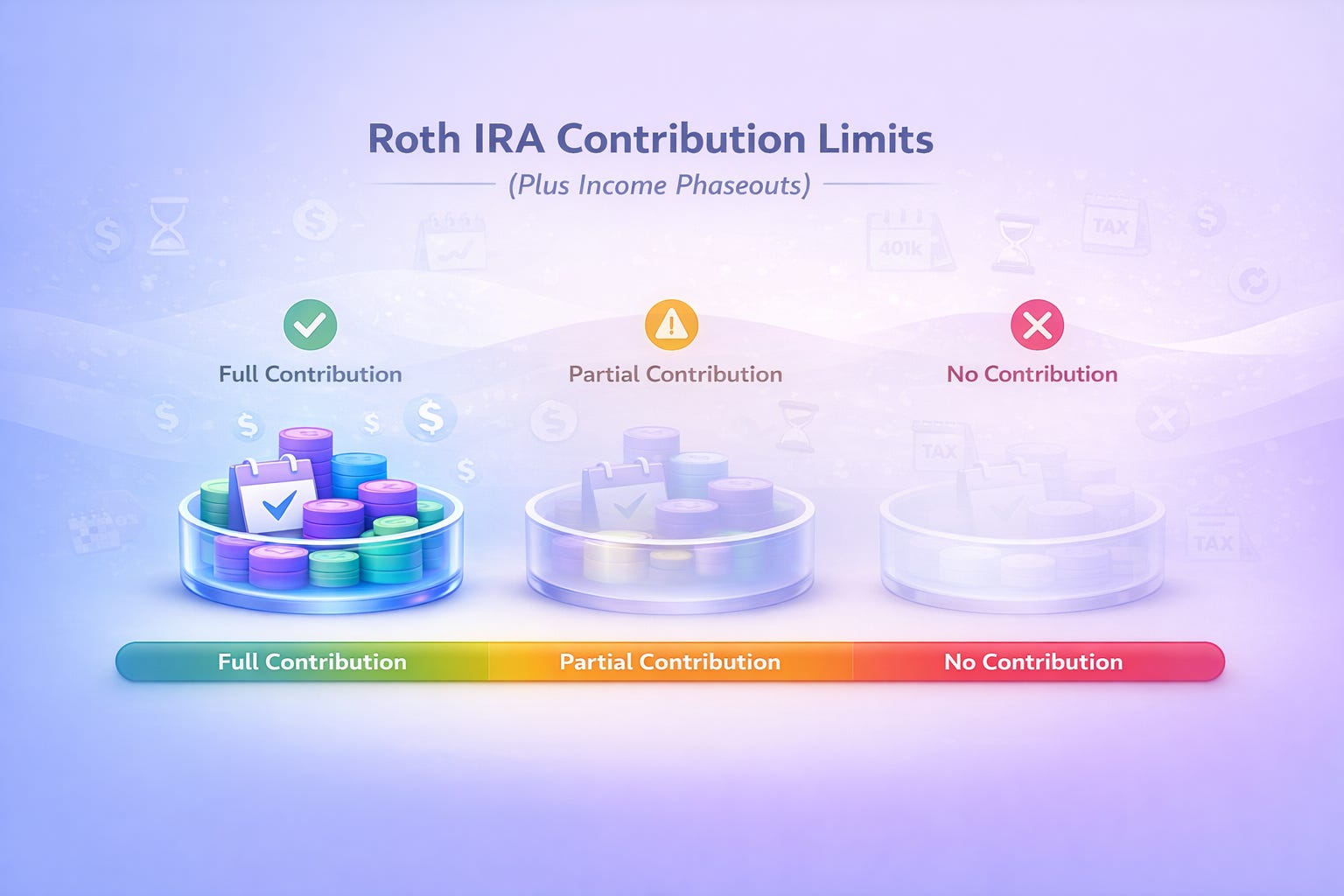
Your earned income determines whether you can make a full contribution, a partial contribution, or none at all. Roth IRA contribution rules IRS requires that contributions cannot exceed your taxable income reported on your federal income tax return.
Roth IRA Contribution Phaseouts
The IRS applies income restrictions through Roth IRA contribution phase-out ranges. For single filers, the ability to make a full Roth IRA contribution begins to phase out at higher income levels. For married filing jointly, the phaseout applies to a different income range.
If your gross income exceeds the income limit, you may only make a partial contribution or use strategies like a backdoor Roth IRA. This involves contributing to a traditional IRA and then converting it into a Roth. While legal, the process must be done carefully to avoid unexpected tax penalties.
Historical Roth IRA Contribution Limits
Looking at the historical Roth IRA contribution limits helps show how the IRS adjusts for inflation. From the early 2000s, at $2,000 per year to the current contribution limit of $7,000, savers have seen steady increases. These adjustments ensure that retirement accounts keep pace with rising income levels and the cost of living.
Self-Employed and SEP Roth IRA Options
If you are self-employed, you may also wonder about self-employed Roth IRA contribution limits or SEP Roth IRA contribution limits. While SEP IRAs traditionally use pre-tax contributions, some providers now allow Roth treatment. The deferral limit for SEP and Solo 401(k) accounts is much higher, but the IRS requires following different contribution rules.
Your employer Roth IRA contribution limits may also vary if you have a workplace retirement plan, such as a 401(k). In these cases, your Roth eligibility depends on your tax filing status and income level.
Excess Roth IRA Contributions and IRS Rules
Contributing more than allowed creates an excess amount. The IRS excess 401k contribution rules are similar to Roth IRAs; any excess contributions to a Roth must be withdrawn. If not corrected by the tax filing deadline (generally April 15 of the following year), you’ll face a penalty tax of 6% per year until the excess amount is removed.
If you already filed your federal income tax return without removing the excess, you may need to file an amended tax return. This ensures your investment earnings and ordinary income tax are properly reported. The IRS requires an excess Roth IRA contribution withdrawal to avoid long-term penalties.
Tax Benefits and Breaks with Roth IRAs
The primary advantage of Roth IRAs is the tax break at retirement: contributions grow tax-free, and qualified withdrawals are exempt from income tax.
Additional benefits include:
● No required minimum distributions during retirement age.
● Contributions (but not earnings) can be withdrawn tax-free before retirement.
● Flexibility for health insurance premiums and other expenses in early retirement.
● Ability to coordinate with Social Security for tax-efficient income planning.
Contribution Rules and Eligibility Requirements To make a Roth IRA contribution, you must meet eligibility requirements:
● You must have earned income (wages, salary, self-employment).
● Contributions cannot exceed your federal income tax return earnings.
● Your filing status (single, married filing jointly, or married filing separately) determines eligibility.
● The first day of the year counts toward the tax year; contributions can be made up to the tax filing deadline the following April.
If you exceed income restrictions, the backdoor Roth IRA remains a legal workaround.
IRA Contributions and Coordination with Other Plans
Your IRA contributions coordinate with employer match rules in a workplace retirement plan. While a Roth IRA is separate from a 401(k), both count toward your overall retirement plan.
High earners often use both: maxing the 401(k) at the deferral limit and then adding a Roth IRA if eligible. For some, a full deduction on a Traditional IRA may be unavailable due to workplace plan coverage, but a Roth IRA offers unique tax credits and growth advantages.
Fidelity Brokerage Services LLC Example
Many savers open Roth IRAs through providers such as Fidelity Brokerage Services LLC, Member NYSE, Salem Street, Boston, MA. Large firms like Fidelity offer Roth accounts with broad investment earnings options and integration with workplace retirement plans. Checking your provider’s rules is key, since each handles excess contributions and withdrawals slightly differently.
Planning for Different Life Situations
Every individual situation is unique. For example:
● A working spouse can help a nonworking spouse contribute.
● Single filers at high incomes may need to consider the backdoor Roth IRA.
● Joint filers with a higher income level may still qualify for a partial contribution.
● Early retirees can withdraw Roth contributions (but not earnings) without penalty to cover health insurance premiums before Medicare eligibility.
Aligning your Roth IRA strategy with your financial situation ensures optimal long-term growth.
Final Thoughts
The Roth IRA contribution limits and income phaseouts play a central role in retirement planning. By understanding the annual contribution limit, knowing how to handle excess contributions, and utilizing strategies such as the backdoor Roth IRA, savers can optimize their retirement plan.
Whether you file as single, married filing jointly, or through a nonworking spouse, the right approach depends on your gross income, filing status, and overall tax year strategy.
At RetireNova, we specialize in guiding clients through the complexities of IRAs, 401(k) plans, and broader retirement planning. From maximizing your total contribution limit to coordinating with Social Security and tax credits, our approach ensures your investment earnings grow efficiently and tax-free.