

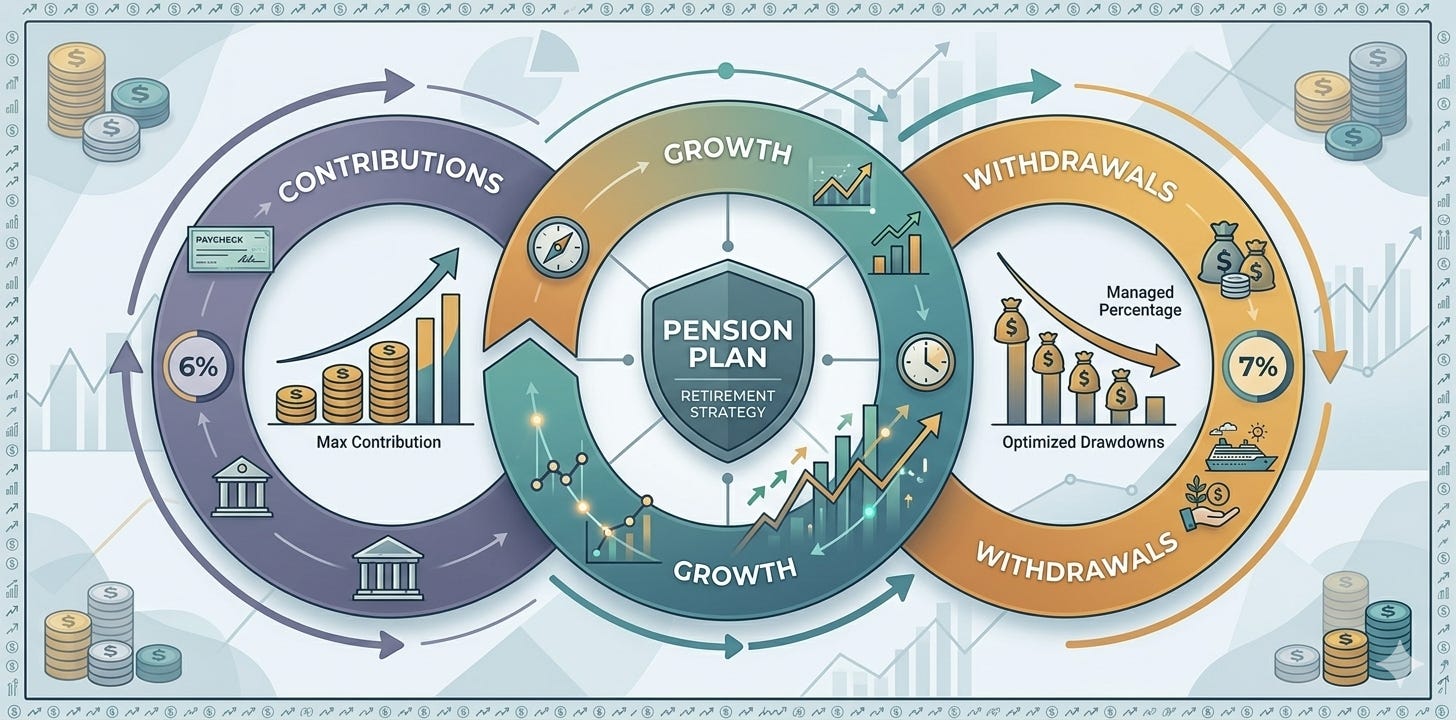
You’ve spent a lifetime working hard and building a secure future. Now, as you approach your retirement years, the focus shifts from accumulating savings to strategically managing your income. For many, a company pension plan is a cornerstone of this financial picture. But are you making the most of it?
Understanding how to maximize your pension contributions in your final working years and strategically plan your pension withdrawals is the key to unlocking a predictable and sustainable retirement income. Let’s walk through some straightforward strategies to help you feel more confident about your financial future.
Making the Most of Contribution Limits for 2025
Your final working years are the moment to lock in bigger tax-advantaged savings. In 2025, maximize every bucket, work plans, IRAs, employer matches, and self-employed options, so each dollar works harder now and funds a steadier, predictable retirement paycheck for decades ahead.
1. Max out 401(k)/403(b): Contribute the full $23,500 (2025 limit) plus catch-ups ($7,500 or even $11,250 if you’re 60–63). Check for Roth (after-tax) options in your plan too.
2. Fully fund IRAs: Put $7,000 ($8,000 if 50+) into a Traditional or Roth IRA. If one type is off-limits due to income, consider splitting between both or doing a backdoor Roth conversion.
3. Capture all employer matches: Contribute enough each paycheck to get the entire company match. As Fidelity notes, maximizing the 401(k) match is “free money” that boosts your savings.
4. Consider SEP/Solo plans: If you have self-employment income, use a SEP IRA or Solo 401(k) to shelter up to 25% of compensation (as employer profit-sharing), roughly $70K in 2025. This can dramatically increase your tax-deferred savings beyond the employee deferral limit.
Balance Traditional and Roth Accounts
How you save is just as important as how much you save. Most retirees benefit from using both Traditional (pre-tax) and Roth (after-tax) accounts.
● Traditional accounts reduce your taxable income today. You’ll owe taxes when you withdraw, but this makes sense if you expect to be in a lower bracket in retirement.
● Roth accounts give you no upfront deduction, but withdrawals are tax-free in retirement. Even better, Roth IRAs have no required minimum distributions (RMDs), which gives you more control later in life.
Think of these as tax “buckets.” By filling both, you create flexibility: you can draw from Roths in high-tax years, Traditional accounts in lower-tax years, and blend the two to smooth out your lifetime tax bill.
High earners who can’t contribute directly to a Roth IRA can still take advantage of a backdoor Roth strategy, making an after-tax IRA contribution and quickly converting it to Roth. If your 401(k) offers Roth contributions, that’s another great way to diversify.
Turn Savings Into a Retirement Paycheck
Once the paychecks stop, the question becomes: How do I turn my savings into steady income? With the right strategy, you can avoid overspending, reduce taxes, and gain confidence that your money will last.
1. Required Minimum Distributions (RMDs)
By law, you must begin withdrawing from Traditional IRAs and 401(k)s at age 73 (rising to 75 for younger retirees). Missing these withdrawals triggers steep penalties. Planning ahead can prevent unpleasant tax surprises. Roth IRAs, on the other hand, have no lifetime RMDs.
2. Social Security and Pensions
Delaying Social Security up to age 70 increases benefits by about 8% per year. If you have a pension, weigh the pros and cons of lump sum vs. lifetime annuity payouts. Together, these guaranteed sources can provide a “floor” of income to cover essentials.
3. The 4% Rule as a Starting Point
A common guideline is to withdraw 4% of your portfolio in year one, then adjust for inflation. For example, a $1 million portfolio would start with $40,000. It’s not a guarantee, but it offers a reasonable baseline to make your money last ~30 years.
4. Multiple Income Streams for Stability
Many retirees like blending:
● Bonds and CDs for predictable interest and maturity schedules.
● Dividend stocks for income and growth potential.
● Annuities to lock in guaranteed lifetime income.
● A total-return portfolio to harvest gains when markets cooperate.
Some retirees use a bucket strategy: keep several years of expenses in cash or bonds, mid-term needs in balanced funds, and long-term growth in equities. This creates a sense of order and helps protect your lifestyle through market ups and downs.
Tax-Savvy Withdrawal Strategies
How you withdraw money can matter as much as how much you saved.
● Sequential strategy: Withdraw first from taxable accounts, then Traditional (tax-deferred), and leave Roth for last. This defers taxable income and allows Roth balances to grow tax-free.
● Proportional strategy: Take withdrawals from each type annually to spread tax liabilities evenly.
Flexibility is key. For instance, in low-income years you might draw more from Roth accounts to avoid bumping into higher tax brackets. In high-income years (due to RMDs), focus on satisfying mandatory withdrawals while letting Roths grow.
Regular portfolio rebalancing and annual reviews are vital. Many retirees use “bucket strategies”, splitting assets into near-term bonds, mid-term balanced funds, and long-term equities, to manage risk across different retirement stages.
Annual Reviews Keep You on Track
Retirement isn’t “set it and forget it.” Each year, it pays to:
● Rebalance your portfolio to maintain your comfort level with risk.
● Revisit withdrawal amounts and make adjustments for inflation or lifestyle changes.
● Check your tax strategy to see if Roth conversions, charitable giving (like Qualified Charitable Distributions), or harvesting gains/losses make sense.
● Update beneficiaries and estate plans to keep everything aligned with your wishes.
Small annual adjustments add up to big improvements over time.
Key Takeaways
● Save aggressively now. Use every available limit plus catch-up provisions. If you’re still working, max your employer match and your IRA contributions.
● Diversify your tax buckets. Balancing Traditional and Roth accounts gives you flexibility later.
● Plan withdrawals with purpose. Think beyond the 4% rule—blend guaranteed income, market assets, and annuities for security.
● Stay mindful of RMDs. Know when they begin and how to fit them into your tax plan.
● Review annually. Adjust spending, rebalancing, and tax tactics to keep income sustainable.
Conclusion
With $500k+ in assets and 10–15 years (or less) to retirement, you have meaningful levers: maximize what goes in, diversify your tax buckets, and sequence what comes out with intention. Pairing strong contributions (especially catch-ups) with a tax-smart, rules-aware withdrawal plan can turn your savings into a confident, sustainable income stream for 20–30 years. If you’d like a tailored blueprint—including Roth conversion windows, Social Security timing, and a bucket plan matched to your lifestyle—this is exactly where an expert advisor adds measurable value.