

Losing your job is devastating. Losing your health insurance at the same time can be financially catastrophic.
When you’re forced into early retirement, healthcare coverage often becomes your largest monthly expense – sometimes exceeding your mortgage payment. Without proper planning, medical costs can quickly drain retirement savings that need to last decades.
But here’s what insurance companies and former employers don’t tell you: you have more options than you think, and some of them can save you thousands of dollars per month.
The Healthcare Crisis Hidden in Plain Sight
The numbers are staggering:
● Average COBRA premiums: $1,778/month for family coverage
● Average ACA marketplace premiums: $1,152/month for family (before subsidies)
● Percentage of early retirees who cite healthcare costs as their biggest concern: 89%
● Average annual healthcare spending for 55-64 age group: $8,640 per person
For someone forced into early retirement at 58, healthcare costs over the 7 years until Medicare eligibility can easily exceed $100,000 – money that comes directly out of retirement savings.
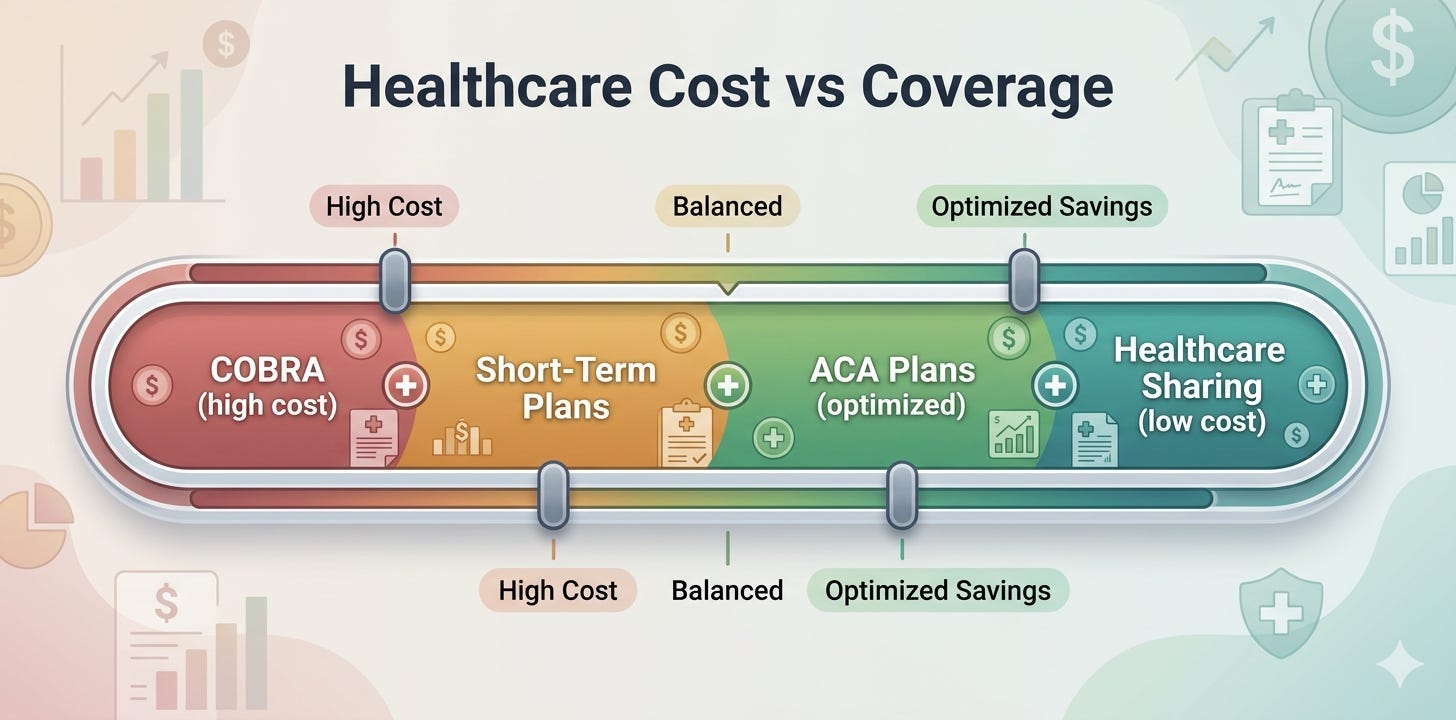
Option 1: COBRA Continuation Coverage
COBRA (Consolidated Omnibus Budget Reconciliation Act) gives you the right to continue your employer’s health insurance temporarily.
The Good News:
● Same coverage, same networks: Keep your doctors and existing care relationships
● No medical underwriting: Can’t be denied for pre-existing conditions
● Immediate coverage: No waiting periods for ongoing treatments
● Prescription continuity: Same formulary and pharmacy networks
The Harsh Reality:
● Expensive: You pay 100% of premium plus 2% administrative fee
● Limited duration: 18 months standard (36 months in some circumstances)
● No employer contribution: What used to cost you $300/month might now cost $1,800/month
● Coverage gaps: If you miss a payment, you lose coverage permanently
COBRA Extension Scenarios:
18 months standard, but can extend to 36 months if:
● You become disabled during the first 60 days
● You experience a second qualifying event (divorce, death of spouse)
● Your employer also provides retiree health benefits
Strategic COBRA Use:
Use COBRA as a bridge while shopping for alternatives:
● Month 1-2: Continue COBRA while exploring other options
● Month 3-18: Transition to more affordable long-term coverage
● Emergency extension: Keep COBRA if you develop serious health conditions
Option 2: ACA Marketplace Plans (Often Your Best Choice)
The Affordable Care Act marketplace can provide comprehensive coverage at a fraction of COBRA costs, especially with premium tax credits.
Understanding Premium Tax Credits:
Income limits for premium tax credits (2024):
● Individual: $30,240 - $60,240
● Family of 4: $62,040 - $124,800
How credits work:
● Available for incomes between 100% and 400% of Federal Poverty Level
● Credits paid directly to insurance company, reducing your monthly premium
● Reconciled on your tax return based on actual income
Real Example:
John and Mary, both 60, annual income $55,000:
● Silver plan premium: $2,100/month
● Premium tax credit: $1,650/month
● Their cost: $450/month
● Annual savings vs. COBRA: $16,200
Marketplace Plan Types:
Bronze Plans (60% actuarial value):
● Lowest premiums, highest deductibles
● Good for healthy people who want catastrophic protection
● HSA-compatible options available
Silver Plans (70% actuarial value):
● Best value for most people
● Cost-sharing reductions available for lower incomes
● Moderate premiums and deductibles
Gold/Platinum Plans (80%/90% actuarial value):
● Higher premiums, lower out-of-pocket costs
● Good for people with ongoing medical needs
● More predictable monthly costs
Cost-Sharing Reductions (CSR):
Available only with Silver plans for incomes under 250% FPL:
● Reduces deductibles, co-pays, and out-of-pocket maximums
● Can make Silver plans better than Gold for total costs
● Must choose Silver plan to receive CSR benefits
Option 3: Healthcare Sharing Plans
Christian-based healthcare sharing plans are not insurance but can provide significant savings for healthy individuals.
How They Work:
● Members contribute monthly amounts to shared pool
● Medical bills submitted to organization for sharing consideration
● Members pray for and support each other’s health needs
● Operates under religious exemption from ACA requirements
Major Organizations:
Samaritan Ministries:
● Monthly shares: $135-$528 depending on family size
● Members send shares directly to families with needs
● Strong community involvement and prayer support
Christian Healthcare Ministries:
● Monthly contributions: $127-$429
● Centralized bill paying system
● Various programs for different coverage levels
Medi-Share:
● Monthly costs: $199-$599 depending on age and family size
● Operates more like traditional insurance
● Provider networks and online bill paying
Important Limitations:
● Pre-existing conditions: Often not covered initially (6-12 month waiting periods)
● Lifestyle requirements: No smoking, limited alcohol, Christian lifestyle expectations
● Not guaranteed: Unlike insurance, sharing is voluntary
● No regulatory protection: Not subject to state insurance regulations
Best Candidates for Sharing Plans:
● Healthy individuals/families
● Strong Christian faith
● Comfortable with community-based approach
● Significant cost savings over traditional insurance
Option 4: Short-Term Medical Plans
Temporary coverage that can bridge gaps between other insurance options.
Advantages:
● Quick approval: Often same-day coverage
● Lower premiums: 50-80% less than ACA plans
● Flexible terms: 1-12 months coverage periods
● No income restrictions: Available regardless of earnings
Significant Limitations:
● No pre-existing condition coverage: Can exclude ongoing medical needs
● Limited benefits: May not cover prescription drugs, mental health, preventive care
● Renewable but not guaranteed: Coverage can be declined upon renewal
● Not ACA-compliant: Doesn’t meet minimum essential coverage requirements
Strategic Use:
Best for healthy people needing temporary coverage:
● Bridging between jobs
● Waiting for Medicare eligibility
● International travel periods
● Gap coverage during insurance transitions
Option 5: International Healthcare Strategies
For adventurous early retirees, international healthcare can provide excellent care at fraction of US costs. Medical Tourism Destinations:
Costa Rica:
● High-quality healthcare system
● English-speaking doctors
● Major procedures cost 60-80% less than US
● Many US retirees use for both routine and emergency care
Mexico:
● Excellent healthcare in major cities
● Prescription drugs often 70-90% cheaper
● Many US border residents cross for routine care
● Growing medical tourism infrastructure
Thailand:
● World-renowned healthcare system
● International-standard hospitals
● Procedures cost 70-85% less than US
● Popular with long-term expat retirees
International Insurance Options:
Cigna Global, Allianz Worldwide:
● Comprehensive international coverage
● Often include US coverage for emergencies
● Premiums typically 40-60% less than US-only plans
● Good for people spending significant time abroad
Option 6: Spouse’s Employment Coverage
If your spouse is still working, their employer coverage might be your best option. Adding to Spouse’s Plan:
● Special enrollment period: Job loss qualifies for immediate enrollment
● Compare costs: Might be cheaper than individual coverage
● Consider plan quality: Compare networks and benefits to your previous coverage
Spousal Coverage Strategies:
If spouse is younger: They might continue working partly for health benefits
If spouse is also older: Coordinate both of your healthcare transitions
Government employees: Often have excellent retiree health benefits
Medicare Bridge Strategies (Ages 62-65)
The closer you are to 65, the more important your Medicare planning becomes.
Medicare Eligibility Rules:
● Age 65: Automatic eligibility regardless of work status
● Disability: 24 months after Social Security disability determination
● End-Stage Renal Disease: Immediate eligibility for kidney patients
Pre-Medicare Planning:
Ages 62-65 require careful bridge planning:
● Maintain continuous coverage: Avoid gaps that could affect Medicare supplements
● Prescription drug planning: Ensure continuity of critical medications
● Provider relationships: Consider impact on doctor relationships
Tax Optimization with Healthcare Costs
Healthcare expenses create significant tax planning opportunities for early retirees. Health Savings Accounts (HSAs):
If you have an HSA from previous employment:
● Triple tax advantage: Deductible contributions, tax-free growth, tax-free withdrawals for medical
● No required distributions: Money can grow indefinitely
● Retirement healthcare fund: Average retiree spends $300,000+ on healthcare
HSA strategies for early retirees:
● Continue contributions if you have HSA-compatible coverage
● Pay current expenses out-of-pocket and let HSA grow
● Save receipts for future tax-free reimbursements
Medical Expense Deductions:
● Threshold: Deductible if exceeding 7.5% of AGI
● Early retirement advantage: Lower AGI makes threshold easier to reach
● Include: Premiums, deductibles, co-pays, prescription drugs, travel for medical care
Premium Tax Credit Optimization:
Strategic income management can maximize ACA subsidies:
● Roth conversions: Don’t count as income for premium tax credits
● Capital gains timing: Manage realization to stay within subsidy ranges
● Traditional IRA withdrawals: Count as income, can push you over subsidy limits
Case Study: The $18,000 Annual Healthcare Savings
Background: Susan, age 61, forced into early retirement from $75,000 job with excellent health benefits.
COBRA option:
● Monthly premium: $1,650
● Annual cost: $19,800
● Same coverage as employed
ACA marketplace strategy:
● Income: $42,000 (part-time consulting + investment withdrawals)
● Silver plan premium: $1,380/month
● Premium tax credit: $1,230/month
● Net monthly cost: $150
● Annual cost: $1,800
● Annual savings: $18,000
Additional benefits:
● Lower deductible due to cost-sharing reductions
● Better prescription drug coverage
● Same quality care through marketplace network
Five-year savings: $90,000 that stays in retirement accounts instead of going to insurance premiums.
The Healthcare Decision Matrix
Choosing the right healthcare strategy depends on multiple factors:
Choose COBRA if:
● You have ongoing serious health conditions
● Your doctors are not in marketplace networks
● You can afford the premiums short-term
● You’re actively job searching
Choose ACA Marketplace if:
● Your income qualifies for premium tax credits
● You’re comfortable changing doctors/networks
● You want comprehensive coverage long-term
● You’re planning permanent early retirement
Choose Healthcare Sharing if:
● You’re in good health with no pre-existing conditions
● You have strong Christian faith
● You’re comfortable with community-based approach
● Cost savings are your primary concern
Consider International Options if:
● You’re open to medical tourism
● You travel frequently or live abroad part-time
● You want premium care at lower costs
● You’re adventurous and flexible
Critical Mistakes to Avoid
❌ Letting COBRA lapse without replacement coverage – Creates pre-existing condition issues
❌ Choosing cheapest plan without considering networks – Your doctors might not be covered
❌ Ignoring prescription drug coverage – Can cost thousands if you need specialty medications
❌ Not reporting income changes to marketplace – Can affect premium tax credits
❌ Assuming you can’t afford coverage – Many options exist for every budget
❌ Delaying enrollment – Missing deadlines can leave you uninsured
Your Healthcare Action Plan
Week 1: Immediate Protection
● Elect COBRA if deadline approaching
● Research ACA marketplace options in your area
● Gather income documentation for subsidy applications
● List all current medications and providers
Week 2-4: Compare and Apply
● Get quotes from marketplace plans
● Research healthcare sharing plans if interested
● Apply for coverage before losing current insurance
● Set up new provider relationships if changing networks
Month 2-3: Optimize and Adjust
● Evaluate first month’s experience with new coverage
● Adjust income projections for premium tax credits
● Explore HSA or medical expense deduction strategies
● Plan for upcoming year’s enrollment period
Getting Professional Help
Healthcare navigation is complex, and mistakes are expensive. Consider professional assistance:
ACA Navigators: Free help understanding marketplace options
Insurance Brokers: Can compare multiple options across different types
Healthcare Advocates: Help with claim issues and provider negotiations
Tax Professionals: Optimize tax strategies related to healthcare costs
Your Next Steps: Protecting Your Health and Wealth
Healthcare costs don’t have to devastate your early retirement dreams. With proper planning and strategy, you can maintain excellent healthcare coverage while preserving your retirement savings.
At RetireNova, our healthcare transition planning includes:
● Comprehensive analysis of all coverage options for your situation
● Premium tax credit optimization strategies
● Coordination with overall retirement income planning
● Provider network analysis to maintain care relationships
● Tax-efficient healthcare cost management
Don’t let healthcare costs derail your retirement security.
[Schedule Your Healthcare Strategy Consultation]
We’ll analyze your specific healthcare needs and show you how to maintain excellent coverage while minimizing costs during your transition to Medicare.
Because your health is your wealth – and both deserve protection.