
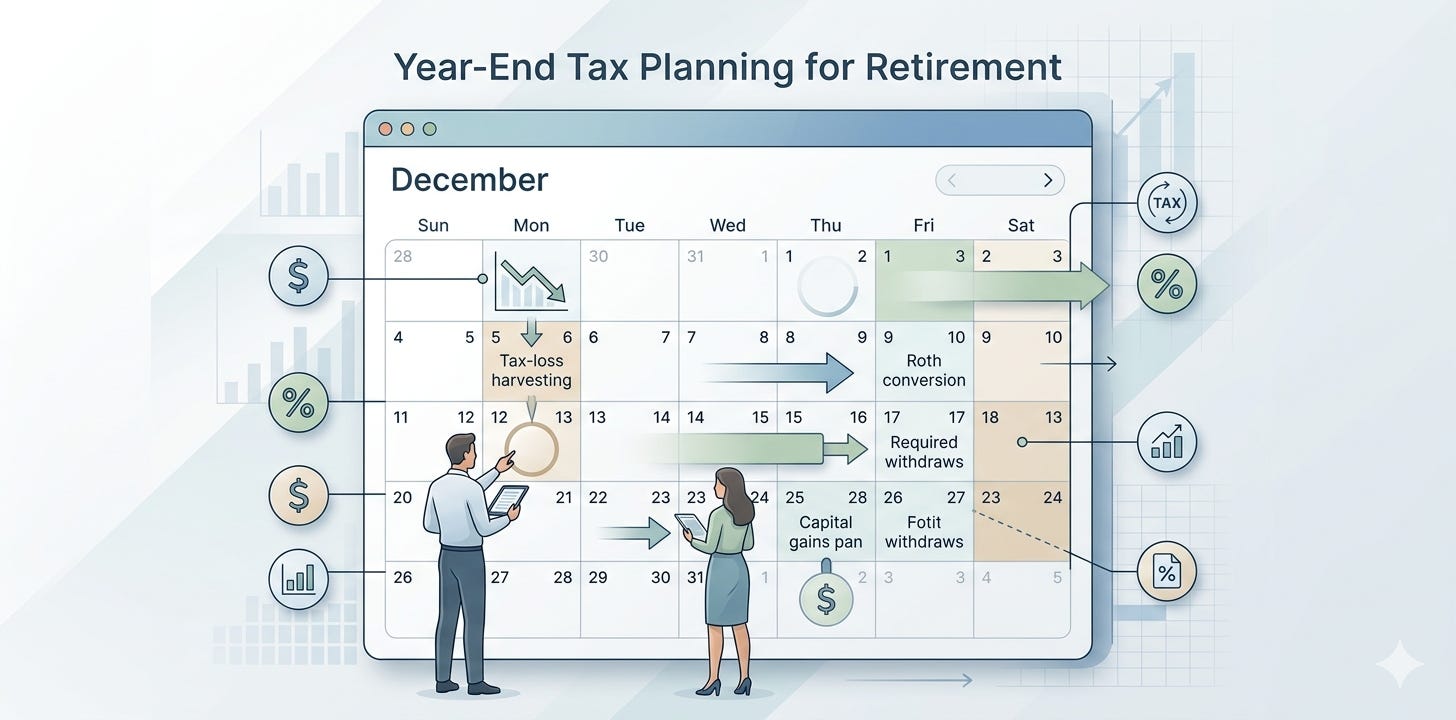
Year‑end tax planning can meaningfully reduce your tax bill, grow retirement savings, and set you up for more secure future income. As the calendar winds down, the window to make strategic moves that count for the current tax year closes — so proactive steps now can have lasting financial impact.
Effective year‑end planning for retirees focuses on:
● Reducing taxable income this year
● Managing Required Minimum Distributions (RMDs)
● Optimizing retirement accounts and contributions
● Leveraging deductions, credits, and tax‑efficient gifting
Many strategies also have timing and eligibility rules that must be satisfied before December 31 to count for the current tax year.
TACTICAL PLAN: Step‑by‑Step Year‑End Tax Actions
Step 1 — Consider Roth Conversions Before Year‑End
A Roth conversion moves funds from a traditional IRA/401(k) to a Roth IRA. Although you pay taxes now, the future growth and qualified withdrawals are tax‑free, and the conversion reduces future RMD obligations. To count for this tax year, conversions must be done by December 31
Tactical Actions
● Use a planning tool to model the tax impact of different conversion amounts.
● Target conversions to “fill up” your current tax bracket without pushing into a higher one.
● Split large conversions over multiple years to avoid spike in tax rates.
Step 2 — Reduce Your Taxable Income
Reducing taxable income lowers your tax liability and may help avoid surcharges like Medicare IRMAA. Corient
Key Moves
● Tax‑loss harvesting: Realize investment losses to offset capital gains and reduce net taxable gains.
● Itemize or bunch deductions: Bundle charitable and medical expenses into a single tax year to exceed standard deduction thresholds.
Step 3 — Take or Manage RMDs
If you’re age 73 or older (or age 75 if born in 1960 or later), you generally must take required minimum distributions from traditional IRAs and other qualified plans by December 31 to avoid penalties.
Tactical Actions
● Verify you’ve taken all required RMDs for the year.
● Consider a Qualified Charitable Distribution (QCD) if you’re age 70½+ — this satisfies your RMD and benefits charity with no taxable income. Corient
Step 4 — Max Out Retirement Contributions
Even retirees with earned income can save on taxes by contributing to traditional IRAs or employer plans:
● Traditional IRA deductible contributions can reduce taxable income.
● Roth IRA contributions (if eligible) grow tax‑free for the future. Vanguard
Tactical Actions
● Maximize contributions up to the limits (with catch‑ups if age 50+).
● If no earned income, consider a backdoor Roth IRA as allowable. Vanguard
Step 5 — Defer Income When Possible
If you have control over timing (e.g., year‑end bonuses, self‑employment income), deferring income into the next year can lower your current tax bill — particularly if you’re already near a higher tax bracket.
Step 6 — Leverage Gift and Estate Tax Exclusions
You can make tax‑free gifts up to the annual exclusion amount without filing a gift tax return. This is a way to transfer wealth without tax consequences, although it doesn’t reduce your income tax. Kiplinger
Step 7 — Coordinate with Medicare IRMAA Planning
Your modified adjusted gross income (MAGI) affects Medicare Part B and D surcharges (IRMAA). Thoughtful planning around withdrawals, conversions, and deductions before year‑end can reduce MAGI and keep IRMAA surcharges lower. Kiplinger
TOP 10 FAQs (With Answers)
1. Why is year‑end tax planning important for retirees?
Year‑end planning allows you to take actions that count for the current tax year, potentially lowering your tax bill now and in the future through smart timing of conversions, deductions, and distributions.
2. What is a Roth conversion and why do it before year‑end?
A Roth conversion moves money from a traditional tax‑deferred account to a Roth account where future earnings can grow and be withdrawn tax‑free. To count for the current tax year, the conversion must be completed by December 31.
3. How do I know if I need to take an RMD?
If you’re age 73 or older (or age **75 for certain birth years), you must take minimum required withdrawals from retirement accounts by year‑end, or face hefty penalties. Corient
4. What is tax‑loss harvesting and who should consider it?
Tax‑loss harvesting is selling investments at a loss to offset taxable gains, reducing your net capital gain. It can be especially useful if you’ve sold securities at a loss during the year.
5. Should I itemize deductions or take the standard deduction?
If your itemized deductions (medical, charitable, state/local taxes) exceed your standard deduction, itemizing may reduce your taxable income. Bundling multiple years’ worth of deductions (like donating to a donor‑advised fund) can help exceed the standard deduction threshold.
6. Can I still contribute to an IRA after age 70½?
Yes — you can contribute to a traditional or Roth IRA as long as you have earned income and meet the income limits for Roth eligibility. Vanguard
7. How do Qualified Charitable Distributions work?
If you’re age 70½ or older, you can make a QCD directly from an IRA to a qualified charity, counting toward your RMD without adding taxable income. Corient
8. What is the annual gift tax exclusion, and does it reduce income tax?
The annual gift tax exclusion lets you give up to a set amount per person tax‑free without filing a gift tax return. It doesn’t reduce your income taxes, but it’s a tax‑efficient way to transfer wealth. Kiplinger
9. How can I lower Medicare IRMAA charges before year‑end?
Lowering your MAGI — through deductions, Roth conversions timed in lower income years, and managing distributions — can help reduce or avoid IRMAA surcharges. Kiplinger
10. When should I consult a tax professional?
When dealing with strategies like Roth conversions, bundling deductions, IRMAA planning, or large RMDs, a tax professional can help ensure you’re optimizing your strategy and complying with IRS rules.