

For decades, government employment has been synonymous with one word: security. Stable paycheck. Reliable pension. Predictable career path. You traded potentially higher private-sector salaries for something more valuable—peace of mind about your financial future.
That certainty is evaporating.
If you are a federal, state, or local government employee over 50, likely with $500,000 or more in assets built through years of disciplined service, the stability you’ve counted on is now threatened by government shutdowns, federal job cuts, and local program funding cuts. The rules you planned around are shifting beneath your feet.
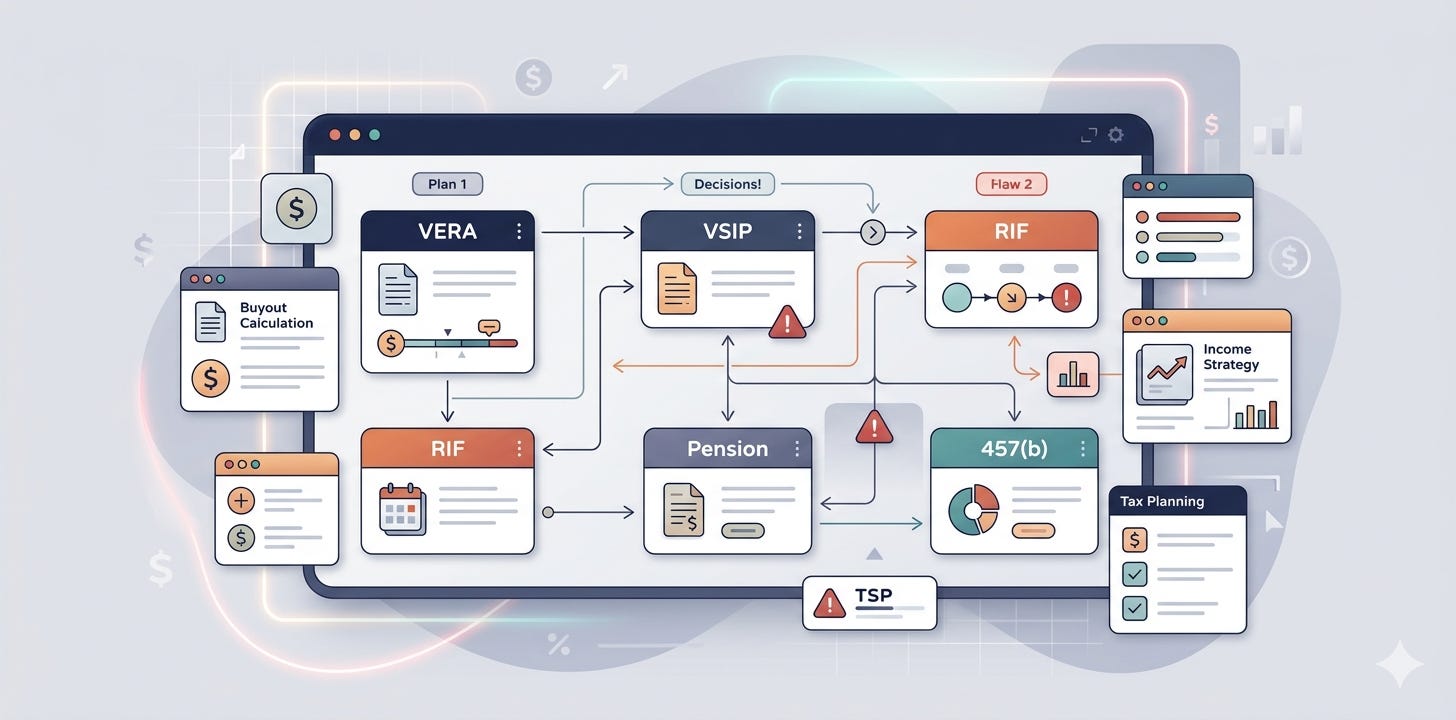
Perhaps you’ve already received an early out offer through VERA (Voluntary Early Retirement Authority) or VSIP (Voluntary Separation Incentive Payment). Maybe you’re watching colleagues disappear through RIF (Reduction in Force) initiatives. Or you’re facing a government shutdown furlough and trying to understand what happens to your FERS pension, TSP, FEHB coverage, and other benefits if your position is eliminated.
This comprehensive guide is your financial roadmap. We’ll move you from anxiety to a concrete plan, covering everything from protecting your assets during shutdowns to analyzing buyout calculations to optimizing your retirement timing. Whether you work for a federal agency with FERS or CSRS benefits, serve New York State with a 457(b) plan, or are part of a local government system like the New York Power Authority, this guide addresses the unique complexities of public pension planning under pressure.
You’ve spent decades serving the public. Now it’s time to protect what you’ve built.
Protecting Your Nest Egg During Instability (Shutdowns & Budget Cuts)
When headlines scream about government shutdowns and budget cuts, it’s natural to worry about your financial security. This section focuses on immediate defensive strategies—protecting what you have when the ground feels unstable beneath you.
What happens to my FERS pension if I’m laid off?
The critical distinction is between immediate retirement and deferred retirement—and this difference is worth hundreds of thousands of dollars.
Immediate retirement means you meet age and service requirements to start collecting your pension right away:
● Minimum Retirement Age (MRA, typically 56-57) with 30 years of service
● Age 60 with 20 years
● Age 62 with 5 years
With immediate retirement, you get your pension now, FEHB (Federal Employees Health Benefits) continuation, and the FERS supplement until age 62.
Deferred retirement means you’re vested (5+ years service) but don’t meet immediate retirement criteria. You leave your pension in the system until age 62, with NO pension income, NO FEHB coverage, and NO FERS supplement until you claim it years later.
Your FERS pension calculation: high-3 average salary × years of service × 1% (or 1.1% if retiring at 62+ with 20+ years).
CSRS employees (hired before 1984) have different, generally more generous formulas but must understand WEP (Windfall Elimination Provision) impact on Social Security if you have mixed employment.
Critical point: Being laid off through RIF doesn’t grant you early retirement privileges. You still need to meet standard eligibility. This is why VERA offers are valuable—they allow immediate retirement without meeting normal age/service requirements.
Action step: Request your retirement estimate from HR immediately to know whether you’d face immediate or deferred retirement if separated today.
How can I protect my TSP during a government shutdown?
Your TSP account itself is secure during shutdowns, but there are real impacts to understand. What’s actually at risk:
● If you’re furloughed without pay, contributions stop (no paycheck = no contributions, no agency match)
● Market volatility may affect your balance, but that’s separate from the shutdown
● You lose compound growth opportunity during unpaid periods
What’s NOT at risk:
● Your existing TSP balance remains fully accessible
● You can still make investment changes between G Fund, C Fund, S Fund, I Fund, and F Fund
● The account doesn’t disappear or freeze
Key protection strategies:
Don’t panic-sell into the G Fund. The biggest mistake during instability is moving everything to the G Fund (Government Securities Investment Fund) out of fear. If you have 10+ years until retirement, you need growth from C Fund (S&P 500) and S Fund (small-cap stocks) to combat inflation.
Maintain 12-18 months emergency fund. The real protection isn’t TSP moves—it’s having accessible cash so you never have to raid retirement accounts during temporary income disruptions.
Consider L Funds for automatic rebalancing. Lifecycle funds (L 2030, L 2035, etc.) automatically adjust between the five TSP funds as you approach retirement, removing emotion from decisions.
For 457(b) plan holders (state/local employees): Similar principles apply. Your account remains secure during budget crises, but contribution interruptions have the same impact—lost matching and compound growth.
What are my options as a NY state employee facing program cuts? New York State employees have distinct options from federal workers:
Early Retirement Incentive (ERI): Periodically offered, typically adding 3 years of service credit. Time-limited windows require quick analysis of whether the incentive offsets reduced pension from leaving early.
Transfer within state service: Your service credit transfers within the state system. Explore moves to more stable agencies before accepting separation.
Deferred retirement: If you have 5+ years but aren’t eligible for immediate retirement, you can claim your pension later (typically age 55 or 62 depending on tier). However, you lose health insurance coverage until you claim the pension.
Critical consideration for state/local employees: Understand WEP and GPO impact. The Windfall Elimination Provision can reduce your Social Security by up to $587/month if you also receive a public pension. The Government Pension Offset can reduce spousal/survivor Social Security benefits by two-thirds of your government pension. This $150,000-200,000+ lifetime impact must be factored into all retirement timing decisions.
What is the impact of federal budget cuts on my retirement date?
Budget cuts create a crucial choice between accepting an early out or risking RIF.
VERA (Voluntary Early Retirement Authority): Allows retirement as early as age 50 with 20 years, or any age with 25 years. Provides immediate retirement status with all benefits—pension starts now, FEHB continues, FERS supplement if under 62.
RIF (Reduction in Force): Involuntary separation with NO special privileges. You must meet standard retirement eligibility or face deferred retirement—meaning no pension until 62, no FEHB coverage for years, and no FERS supplement ever.
The critical distinction: Declining VERA doesn’t protect you from later RIF. If you’re later RIF’d without meeting immediate retirement eligibility, you lose all the benefits VERA would have provided.
Indirect impacts on your high-3 average salary: Budget cuts often freeze salaries, eliminate bonuses, and reduce overtime. Since your pension is based on your highest 3 consecutive years of salary, frozen pay in peak earning years reduces lifetime pension value.
Join our live call-in podcasts this November and December on YouTube, and follow our social media for free expert guidance on VERA, VSIP, RIF planning, WEP/GPO strategies, TSP optimization, and other critical federal and public pension topics—get the professional answers you need at no cost.
Evaluating an Early Exit: Your Guide to VERA & VSIP Buyouts
When the offer letter arrives, you face a concrete decision with a ticking clock. Here’s the framework to evaluate whether accepting serves your long-term interests.
Should I take the VERA/VSIP buyout offer?
This requires systematic buyout calculation comparing immediate retirement now versus continuing to work.
Step 1: Calculate true offer value
VERA provides immediate retirement status:
● Pension starts immediately (high-3 × years × 1%)
● FERS supplement until 62 (if eligible)
● FEHB continuation
● TSP preservation with penalty-free access if 55+
● Annual leave payout
VSIP adds up to $25,000 cash incentive (approximately $18,000-20,000 after taxes).
Step 2: Calculate cost of accepting
If you decline and work to planned retirement:
● Additional salary years
● Continued TSP contributions and 5% agency match
● Additional service years (each adds ~1% to pension)
● Potential salary increases in high-3 calculation
Example: Accepting VERA at 58 instead of 62 means losing 4 years of $100,000 salary ($400,000), plus $20,000 in TSP match, plus $4,000/year permanently lower pension. Total opportunity cost: $420,000+ in lifetime value.
Step 3: Compare immediate vs. deferred retirement scenarios
This comparison is critical and often misunderstood:
Factor VERA (Immediate Retirement) Deferred Retirement (if RIF’d)
Immediately Age 62
When pension starts
FERS Supplement Yes (if under 62) Never
FEHB Continuation Yes, with employer contribution No coverage until pension claimed
FEGLI Options Can continue with options Very limited TSP access Penalty-free if 55+ 10% penalty until 59½
Pension amount Based on current high-3 Same amount, but delayed 5-10 years
The 7-year cost of deferred retirement: If you’re 55 and face deferred retirement until 62:
● Zero pension income: 7 years × ~$30,000 = $210,000 lost
● Zero FERS supplement: 7 years × ~$10,000 = $70,000 lost
● Health insurance costs: ~$1,200/month × 84 months = $100,000
● Total disadvantage: ~$380,000
This is why VERA’s immediate retirement status is so valuable—it’s not just about the VSIP cash payment.
Strong reasons to ACCEPT:
● Close to planned retirement anyway (within 2-3 years)
● Substantial assets beyond pension ($750,000+ in TSP/457b)
● High probability of later RIF (declining won’t save your job)
● Already meet immediate retirement eligibility
● Health or personal circumstances favor exit
Strong reasons to DECLINE:
● More than 5 years from planned retirement
● Limited assets (under $300,000 in retirement accounts)
● Significant debt or unfunded obligations
● Position appears secure (no immediate RIF risk)
● Need to improve high-3 average salary
Critical consideration: If you decline VERA and are later RIF’d without meeting immediate retirement criteria, you face deferred retirement and lose $200,000-400,000 in benefits. This risk must be weighed against the opportunity cost of accepting.
What is the best way to invest my TSP after taking a buyout? You have three options: leave in TSP, roll to IRA, or combination approach.
Leave in TSP
Advantages: Lowest fees anywhere (0.042%-0.058% expense ratios), access to unique G Fund, institutional pricing on C/S/I/F Funds, simple management, age 55 penalty-free withdrawal rule.
Disadvantages: Limited to five core funds plus L Funds, no Roth conversion capability while in TSP, rigid withdrawal rules, limited beneficiary options.
Roll to IRA
Advantages: Unlimited investment options, Roth conversion flexibility (critical for tax optimization), flexible distributions, sophisticated beneficiary planning, professional management options.
Disadvantages: Higher fees (0.15%-0.50%+), complexity, lose G Fund access and institutional pricing, irreversible decision.
The age 55 rule is critical: If you separate from federal service at 55+, you can access TSP penalty-free even though you’re under 59½. Roll to an IRA and you lose this—must wait until 59½ or face 10% penalties.
For 55-59 year-olds needing retirement account income: strongly consider leaving TSP in place for penalty-free access.
For sophisticated tax planning: Consider combination approach—roll enough to IRA for Roth conversion pipeline, leave remainder in TSP for low-cost G Fund exposure.
457(b) advantage for state/local employees: These plans allow penalty-free withdrawals at ANY age after separation from service—even more valuable than TSP’s age 55 rule. Carefully consider before rolling over.
Join our live call-in podcasts this November and December on YouTube, and follow our social media for free expert guidance on VERA, VSIP, RIF planning, WEP/GPO strategies, TSP optimization, and other critical federal and public pension topics—get the professional answers you need at no cost.
Long-Term Wealth Strategy for High-Income ($500k+) Public Servants
With substantial assets, your planning shifts from survival to optimization. Here are the sophisticated strategies that maximize your lifetime wealth.
How do I coordinate my FERS supplement and Social Security?
The FERS supplement is a bridge payment designed to approximate your Social Security benefit from retirement until age 62. Understanding how to optimize this coordination is worth tens of thousands.
How the FERS supplement works:
● Only available with immediate retirement (NOT deferred retirement)
● Calculated based on Social Security formula and years of FERS service
● Ends at age 62 regardless of when you claim Social Security
● Taxable as ordinary income
● Subject to earnings test if you return to work
The optimization strategy: The supplement creates a unique opportunity to delay Social Security beyond 62 for maximum benefits. Since you’re receiving approximation of Social Security from your supplement, you can let your actual Social Security grow 8% per year by delaying from 62 to 70.
Example: $2,000 monthly benefit at full retirement age becomes:
● $1,400/month if claimed at 62
● $2,480/month if delayed to 70
● Lifetime difference: $300,000+ over 30-year retirement
WEP/GPO complications: If Windfall Elimination Provision or Government Pension Offset applies to you (common with CSRS or state/local pensions), your Social Security calculation changes dramatically. WEP can reduce benefits by $200-500/month, and GPO can eliminate spousal/survivor benefits entirely. This requires specialized calculation—don’t attempt DIY.
Coordinated strategy for $500k+ households: Use FERS supplement (age 62-62) + FERS pension + TSP strategic withdrawals to delay Social Security to 70. This maximizes guaranteed inflation-adjusted lifetime income while preserving portfolio longevity.
What is the most tax-efficient withdrawal strategy for my pension and 457(b) plan?
With multiple income sources, withdrawal sequencing can save $100,000+ in lifetime taxes.
The tax bucket strategy:
Bucket 1 - Taxable accounts (brokerage, savings): Withdraw first. These have most flexibility and lowest tax impact with long-term capital gains rates.
Bucket 2 - Tax-deferred (TSP, traditional IRA, 457b): Strategically convert to Roth during low-income years. For early retirees (55-62), you’re not yet receiving Social Security, creating a “low-income window” perfect for Roth conversions at reduced tax rates.
Bucket 3 - Tax-free (Roth TSP, Roth IRA, HSA): Preserve these longest. Tax-free growth and withdrawals provide maximum flexibility in high-income years and legacy planning.
The Roth conversion opportunity: After taking early retirement but before Social Security begins, you may have several years in the 12% or 22% tax bracket. Converting traditional IRA/TSP funds to Roth during these years means:
● Paying taxes at lower rates than during working years
● Creating tax-free income for later when pension + Social Security push you to higher brackets
● Reducing Required Minimum Distributions at 73
● Lowering taxes on Social Security benefits (up to 85% is taxable based on other income) Example strategy for VERA retiree at 58 with $600k TSP:
● Years 58-62: Live on pension + FERS supplement, convert $40,000/year TSP to Roth (stay in 22% bracket)
● Years 62-70: Delay Social Security, draw from Roth conversions + remaining TSP
● Age 70+: Claim maximized Social Security, draw from Roth tax-free, minimize RMD impact
457(b) specific advantage: Unlike TSP/401k, 457b plans have no 10% early withdrawal penalty at any age after separation. This makes them ideal for early retirement income while preserving IRA/TSP for Roth conversions.
Critical mistake to avoid: Don’t convert so much that you lose ACA (Affordable Care Act) premium subsidies if you’re under 65. MAGI (Modified Adjusted Gross Income) thresholds determine subsidy eligibility—proper conversion amounts require precise calculation.
Your Action Plan
If you’ve received VERA/VSIP offer (30-60 day window):
● [ ] Request all documentation: pension calculation showing high-3, FEHB continuation, FEGLI options
● [ ] Determine immediate vs. deferred retirement status if you decline
● [ ] Calculate lifetime value of accepting vs. declining with proper buyout calculation
● [ ] Assess WEP/GPO impact on Social Security if applicable
● [ ] Model 10-year cash flow under both scenarios
● [ ] Consult fee-only advisor specializing in federal benefits before deadline
● [ ] Submit decision before window closes
If facing potential RIF or planning ahead:
● [ ] Get current pension estimate showing high-3 average salary and years
● [ ] Calculate years to immediate retirement eligibility
● [ ] Understand your agency’s RIF procedures and seniority protections
● [ ] Build 12-18 month emergency fund
● [ ] Review TSP allocation (don’t be 100% in G Fund with 10+ year horizon)
● [ ] Verify FEHB 5-year requirement for retirement continuation
● [ ] Model various separation dates: now vs. MRA vs. 62 vs. planned retirement
Moving Forward with Confidence
Federal, state, and local government retirement planning is uniquely complex. The intersection of FERS/CSRS pensions, FERS supplement, TSP/457b plans, FEHB continuation, WEP/GPO rules, and early-out decisions (VERA/VSIP vs. RIF) creates challenges that require specialized expertise.
The difference between accepting and declining a VERA offer can be $200,000-500,000 in lifetime value. The difference between immediate and deferred retirement can be $300,000+. These aren’t decisions to make alone or with a generalist advisor who’s never worked with government employees.
You’ve spent decades building financial security through public service. Your next step is protecting and optimizing what you’ve built—not with guesswork, but with expert guidance from someone who understands high-3 calculations, buyout analysis, WEP/GPO impact, and the nuances of public pension systems.
Whether you’re evaluating a buyout, facing RIF, or planning for uncertainty, the cost of specialized advice ($2,000-5,000 for comprehensive analysis) is minimal compared to the six-figure decisions at stake.