

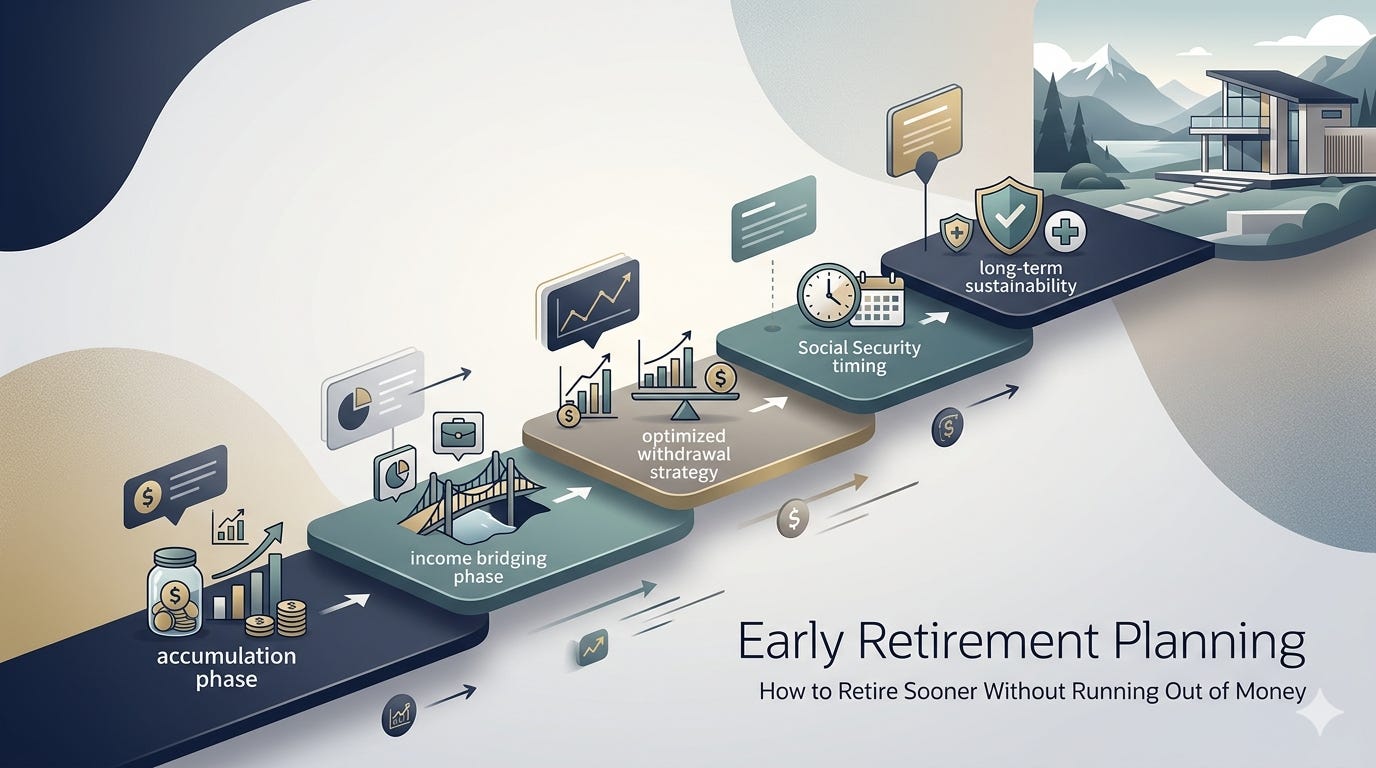
Introduction: The New American Dream
Once, retiring at 65 was the milestone everyone aimed for. Now, more people are chasing something different — the ability to walk away from full-time work in their 50s, 40s, or even earlier.
The appeal is obvious: more years of health and energy to travel, explore passions, or simply live life on your own terms. But there’s a catch — those extra years without a paycheck require a bigger financial cushion, smarter tax moves, and careful planning to avoid running out of money.
This guide breaks down exactly how to structure your finances, lifestyle, and mindset for a successful early retirement.
1. Define Your Early Retirement Lifestyle
An early retirement plan begins with clarity on what you want life to look like when you stop working. Ask yourself:
● Will you live in a high-cost city or relocate somewhere cheaper?
● How will you spend your time — travel, hobbies, part-time work, volunteering?
● Are you downsizing your home, or keeping it as a base?
This isn’t fluff — these decisions set the foundation for your budget and the size of the nest egg you’ll need.
Example: A couple retiring at 50 in Austin, Texas with plans to travel abroad twice a year will need a significantly larger budget than a couple retiring in a low-cost rural area.
2. Estimate Your Retirement Number — With Extra Caution
If you plan to retire early, your money has to last longer than the traditional 20–30 years — maybe 40+ years. This increases the risk of sequence-of-returns risk (bad market years early in retirement hurting your portfolio) and inflation’s impact.
Steps:
1. Calculate annual spending in today’s dollars.
2. Multiply by at least 30–35 times instead of the usual 25x.
3. Add a buffer for healthcare and unexpected expenses.
Pro Tip: For early retirees, conservative withdrawal rates of 3–3.5% are safer than the traditional 4%.
3. Save Aggressively — and Intentionally
You don’t just need to save more, you need to save faster. That means:
● Maxing out tax-advantaged accounts: 401(k), 403(b), IRA, and HSA if eligible.
● Using taxable brokerage accounts: Gives you flexibility to access funds before age 59½ without penalties.
● Tracking your savings rate: Early retirees often aim for 50–70% of their income saved.
4. Create Early Retirement Income Streams
You’ll need income sources that bridge the gap between early retirement and when benefits like Social Security and Medicare kick in.
Options include:
● Taxable investment accounts for penalty-free withdrawals.
● Dividend-paying stocks or REITs for ongoing cash flow.
● Rental income from real estate.
● Part-time or seasonal work to reduce withdrawals in down markets.
● Annuities with earlier payout starts (though these reduce liquidity).
5. Plan for Healthcare Before 65
One of the biggest hurdles for early retirees is covering health insurance before Medicare eligibility. Your options may include:
● ACA Marketplace Plans: Premium subsidies may be available if your taxable income is low.
● COBRA Coverage: Extends your employer plan for up to 18 months after leaving work.
● Health Sharing Ministries: Lower-cost alternatives, though with limitations.
● HSAs: Build up balances while working to cover tax-free medical costs later.
6. Minimize Taxes With Strategic Withdrawals
Early retirement tax planning is about avoiding penalties and keeping taxable income low:
● Rule of 55: Allows penalty-free withdrawals from a 401(k) if you leave your job at age 55 or older (applies to that employer’s plan).
● Substantially Equal Periodic Payments (SEPP): Structured withdrawals that avoid penalties but lock you into a schedule.
● Tax-gain harvesting: In low-income years, you can realize capital gains at 0% federal tax rate.
7. Protect Against Inflation and Longevity Risk
With decades ahead of you, inflation can be devastating. Combat it with:
● Equity investments: Stocks historically outpace inflation over the long term.
● Real estate: Rental income often rises with inflation.
● TIPS: Treasury Inflation-Protected Securities for guaranteed inflation adjustments.
8. Stress-Test Your Plan for Early Retirement Scenarios
Run simulations that test:
● A market crash in the first 5 years.
● Higher-than-expected medical costs.
● Living 10 years longer than planned.
● Needing to financially assist family members.
9. Build a Flexible Spending Plan
In early retirement, flexibility is your safety net. Be ready to:
● Reduce discretionary spending in down markets.
● Delay large purchases until portfolios recover.
● Take on temporary work if conditions change drastically.
Conclusion: Early Retirement Is Possible, But Not Accidental
Early retirement isn’t just a bigger version of traditional retirement — it’s an entirely different game. It demands a higher savings rate, creative income solutions, and more careful planning around taxes and healthcare.
If you’re willing to plan meticulously and adapt as life unfolds, retiring at 50, 45, or even 40 isn’t just possible — it’s achievable.