
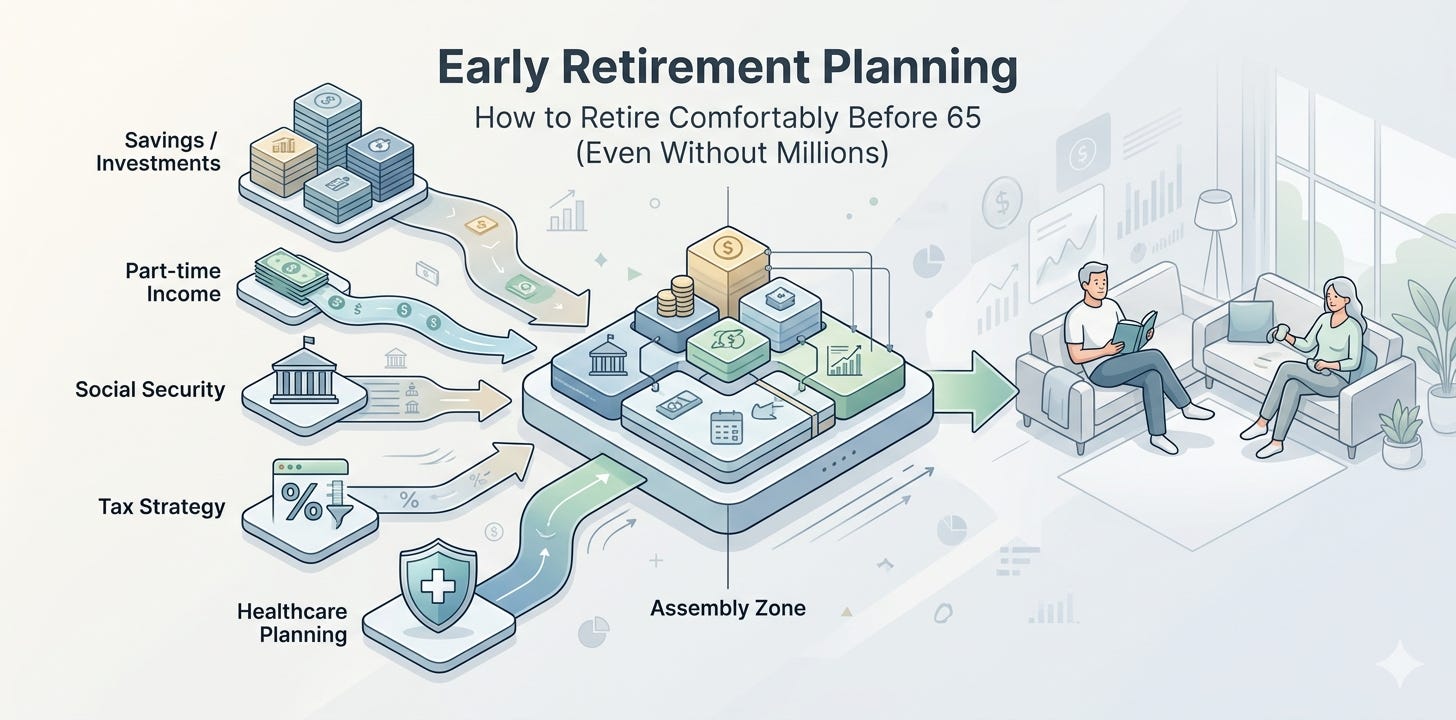
“I can’t retire until 65 – I don’t have millions saved.”
This limiting belief keeps millions of Americans trapped in jobs they’ve outgrown, postponing their dreams until “someday” that may never come.
But what if I told you that early retirement isn’t just for tech millionaires and lottery winners? What if you could retire comfortably in your 50s – or even earlier – with careful planning and the right strategies?
The truth is, early retirement is more achievable than ever, and it doesn’t require winning the startup lottery or inheriting a fortune. It requires understanding the math, optimizing your approach, and making strategic decisions that most people never consider.
The Early Retirement Math: Less Than You Think
The conventional wisdom says you need $1-2 million to retire. But this assumes you’re replacing your full working income and waiting until 65 to claim Social Security.
Early retirement changes the equation:
Lower living costs: No work clothes, commuting, eating out for lunch, work travel
Reduced taxes: Lower income often means lower tax brackets
Healthcare subsidies: ACA premium tax credits can dramatically reduce insurance costs
Geographic flexibility: You can live anywhere, potentially in lower-cost areas
Active lifestyle: More time for cooking, exercise, and free activities
Real example: Sarah and Mike were spending $85,000 annually while working. In early retirement, they live comfortably on $55,000 – a 35% reduction without feeling deprived.
The Bridge Strategy: Getting from Here to Social Security
The biggest challenge in early retirement isn’t accumulating wealth – it’s bridging the gap until Social Security and Medicare kick in.
Years 50-62: No Social Security available
Years 62-65: Reduced Social Security available, no Medicare
Age 65+: Full benefits available
Bridge Strategy 1: The Ladder Approach
Ages 50-62: Live off investment accounts and cash reserves
Age 62: Claim reduced Social Security if needed
Age 65: Optimize Medicare enrollment
Age 67: Switch to full Social Security benefits
Bridge Strategy 2: The Roth Conversion Acceleration
Ages 50-65: Convert traditional IRAs to Roth during low-income years
Live off Roth contributions (penalty-free after 5 years)
Minimize taxes during prime conversion years
Set up tax-free income for later retirement
Healthcare: The Early Retirement Wild Card
This is often the biggest concern for early retirees, but solutions exist:
ACA Marketplace with Premium Tax Credits:
Income limits for 2024: Up to $103,000 for family of four
Premium tax credits can reduce costs to $200-500/month
Silver plans with cost-sharing reductions provide excellent value
Healthcare Sharing Plans:
Christian-based alternatives to traditional insurance
Often 50-70% less expensive than ACA plans
Not technically insurance, but provides coverage for major expenses
Short-term Medical + Catastrophic Coverage:
Combination of short-term plans and catastrophic policies
Covers major medical expenses while keeping premiums low
Requires more management but significant cost savings
International Healthcare:
Many early retirees spend winters abroad where healthcare is excellent and affordable
Countries like Costa Rica, Portugal, and Thailand offer high-quality care at fraction of US costs
The FIRE Movement: Lessons from the Extremes
Financial Independence, Retire Early (FIRE) has three main variations:
Lean FIRE: $500,000-750,000 saved, living on $25,000-35,000 annually
Regular FIRE: $1-1.5 million saved, living on $40,000-60,000 annually
Fat FIRE: $2.5+ million saved, maintaining higher lifestyle in retirement
Key FIRE principles that apply to everyone:
High savings rates (20-50% of income)
Aggressive expense optimization
Geographic arbitrage (living in lower-cost areas)
Side income development
Tax optimization strategies
You don’t need to go to FIRE extremes to retire early – but borrowing their strategies can accelerate your timeline by 5-10 years.
The House Hack: Your Home as Retirement Asset
Your home is probably your largest asset, and it can fund early retirement in several ways:
Strategy 1: Downsize and Pocket the Difference
Sell expensive family home, buy smaller retirement home with cash
Invest the difference in income-producing assets
Eliminate mortgage payments from retirement budget
Example: Sell $800,000 home, buy $400,000 retirement home, invest $400,000 difference. At 4% withdrawal rate, that’s $16,000 annual income plus no mortgage payment.
Strategy 2: Geographic Arbitrage
Sell high-cost area home, move to lower-cost area
Your money goes 2-3x further in many parts of the country
Often better weather and lifestyle as bonus
Strategy 3: House Hacking
Buy duplex or house with rental potential
Live in one part, rent out the rest
Rental income covers most or all housing costs
Tax Optimization: The Early Retiree’s Secret Weapon
Early retirement creates unique tax optimization opportunities:
The Zero Tax Years:
With careful planning, early retirees can have $0 federal tax liability
Standard deduction ($29,200 for married couples in 2024) covers basic income
Long-term capital gains are 0% for low-income taxpayers
Roth Conversion Golden Years:
Convert traditional IRA funds to Roth during low-income early retirement years
Pay taxes at 12% bracket instead of 22-32% during working years
Creates tax-free income for later retirement
ACA Premium Tax Credit Optimization:
Income between 100-400% of federal poverty level qualifies for premium tax credits
Strategic income management can result in nearly free health insurance
Roth withdrawals don’t count as income for ACA purposes
The Part-Time Transition Strategy
You don’t have to go from full-time work to complete retirement overnight.
Phased retirement options:
Consulting: Use your expertise on your own terms
Part-time employment: Reduce stress while maintaining some income
Seasonal work: Work during peak seasons, vacation during off-seasons
Passion projects: Turn hobbies into modest income streams
Benefits of part-time income:
Reduces pressure on investment withdrawals
Maintains social connections and purpose
Provides flexibility to increase income if needed
Often more engaging than full-time employment
Case Study: The Thompson Early Retirement at 58
Background:
Combined income: $120,000
Savings: $850,000 in retirement accounts
Goal: Retire at 58 (7 years before Social Security)
The challenge: Traditional advice said they needed to work until 67.
Our early retirement strategy:
Years 58-62 (Bridge Period):
Live on $60,000 annually (reduced from $85,000 working budget)
Fund from taxable investments and cash reserves: $240,000
Healthcare: ACA marketplace with premium tax credits
Years 62-67:
Claim reduced Social Security: $3,200/month combined
Supplement with investment withdrawals: $1,500/month
Continue ACA healthcare until Medicare eligible
Years 67+:
Switch to full Social Security: $4,400/month combined
Medicare for healthcare
Investment accounts have continued growing
Result: They retired at 58 with confidence their money would last beyond age 95, and their investment accounts actually grew during early retirement due to market performance and tax optimization.
The Pension Advantage: If You Have One
If you’re lucky enough to have a pension, early retirement becomes much easier:
Teacher pensions: Often available at 55-60 with full benefits
Government pensions: Usually have early retirement options with modest reductions
Corporate pensions: Rare but often include early retirement provisions
Optimization strategies:
Understand exact pension calculation formulas
Consider working additional years if pension increases significantly
Coordinate pension timing with Social Security optimization
Plan for pension taxation in retirement states
Common Early Retirement Mistakes to Avoid
Mistake 1: Underestimating healthcare costs Solution: Budget $1,500-2,500/month for family coverage until Medicare
Mistake 2: Ignoring inflation Solution: Plan for 3% annual inflation over 30+ year retirement
Mistake 3: Over-optimistic investment returns Solution: Use conservative 6-7% return assumptions, not 10%+
Mistake 4: Forgetting about taxes Solution: Plan withdrawal strategies that minimize tax burden
Mistake 5: No contingency planning Solution: Have backup plans for market crashes, health issues, or family emergencies
The Happiness Factor: Why Early Retirement Works
Research shows early retirees are generally happier and healthier than traditional retirees:
Freedom: Control over time and daily activities
Health: Less stress leads to better physical and mental health
Relationships: More time for family and meaningful friendships
Purpose: Opportunity to pursue passions and volunteer work
Adventure: Travel and experiences while still young and healthy
The key: Early retirement works best when you’re retiring TO something, not just FROM something.
Your Early Retirement Action Plan
Step 1: Calculate your true retirement needs
Analyze current spending and identify retirement reductions
Factor in healthcare, taxes, and inflation
Determine your actual target number (often 25x annual expenses)
Step 2: Optimize your savings rate
Track every expense for 3 months
Identify biggest opportunities for savings
Automate investments to pay yourself first
Step 3: Develop your bridge strategy
Plan healthcare coverage for early retirement years
Optimize Social Security claiming strategy
Consider part-time income options
Step 4: Tax optimization planning
Maximize Roth conversions during low-income years
Plan withdrawal sequences to minimize taxes
Consider geographic arbitrage for tax advantages
Getting Professional Help for Early Retirement
Early retirement planning is complex and requires specialized expertise:
At RetireNova, we specialize in early retirement strategies that include:
Detailed cash flow modeling for various retirement ages
Healthcare cost planning and insurance optimization
Tax-efficient withdrawal and conversion strategies
Social Security optimization for early retirees
Part-time income integration planning
Stress testing for various market scenarios
Our early retirement analysis typically shows clients how to retire 3-7 years earlier than they thought possible.
Ready to discover your early retirement possibilities?
[Schedule Your Early Retirement Strategy Session]
We’ll analyze your specific situation and show you exactly what it would take to retire on your timeline, not the government’s.
Because life is too short to spend it waiting for “someday.”