
Introduction
You’ve worked hard, saved consistently, and done your best to prepare for retirement. But if you’re one of the many professionals with access to both a 401(k) and a 457(b) plan, you might be sitting on one of the most powerful and underused savings opportunities available.
Most people assume you can contribute only up to the IRS limit across all plans. The truth? You can fund both a 401(k) and a 457(b) in the same year, effectively doubling your tax-advantaged savings.
At RetireNova, we help clients use these dual-plan strategies to build predictable, flexible income systems, not just accounts that grow, but plans that work.
Let’s break down how these two plans differ, how their contribution limits stack, and what it really means for your 2025 retirement strategy.
Understanding the Basics: What Each Plan Does
A 401(k) and 457(b) may look similar on paper, but their structure, purpose, and flexibility make them distinct tools in your retirement toolkit.
401(k):
Common in the private sector.
Contributions can be pre-tax or Roth (after-tax).
Often includes an employer match or profit-sharing feature.
Early withdrawals (before age 59½) usually trigger a 10% penalty plus income tax.
457(b):
Typically available to state and local government employees or nonprofit workers.
No early withdrawal penalty once you separate from service, even before 59½.
Contributions are pre-tax and grow tax-deferred.
In simple terms:
Think of your 401(k) as your main power source, reliable and strong, while your 457(b) acts like a backup generator, giving you more control and flexibility if life takes an early turn toward retirement.
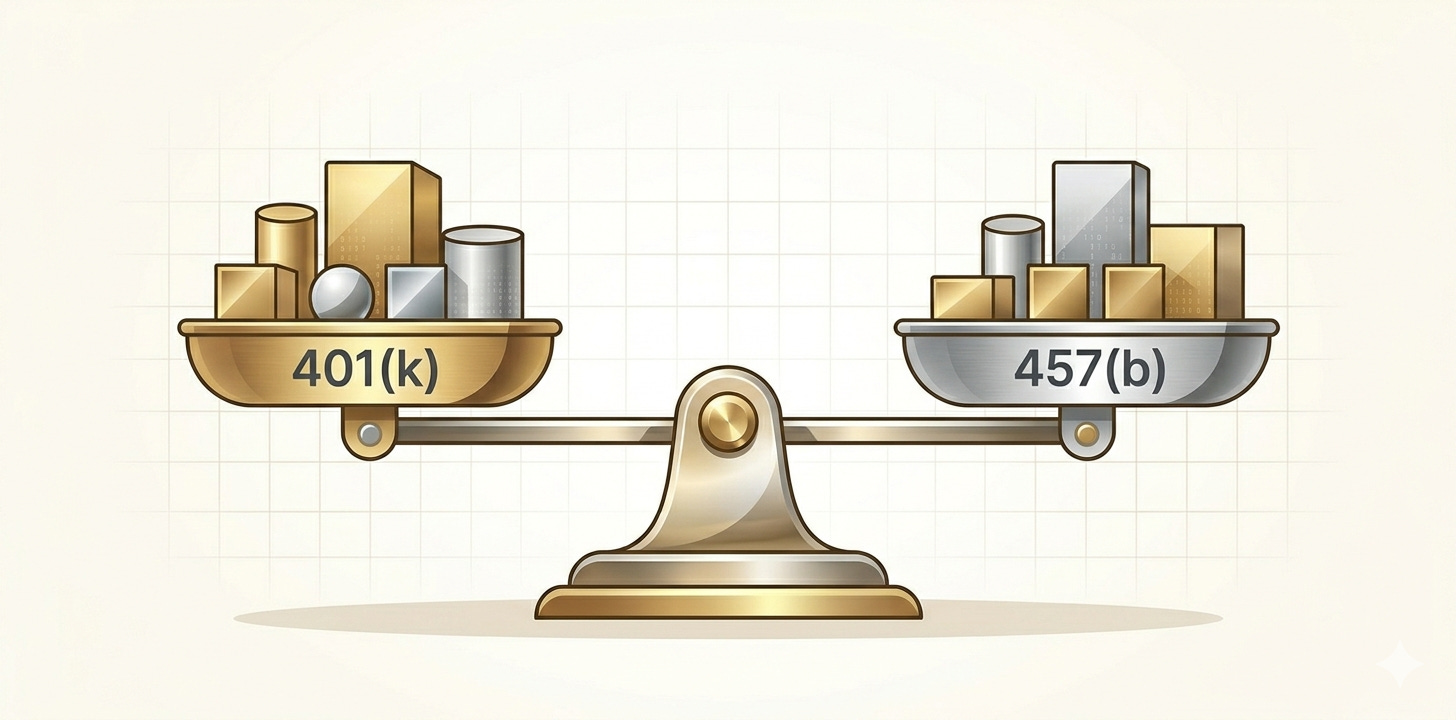
Can You Contribute to Both a 401(k) and 457(b)? Yes, absolutely, and this is where the real opportunity lies.
The IRS treats 401(k) and 457(b) plans as separate contribution buckets. That means the limits for one don’t reduce what you can put in the other. You can maximize both without overlap.
Here’s how it works in 2025:
401(k) employee limit: $23,500
457(b) employee limit: $23,500
Total potential: $47,000 in combined employee contributions
If age 50 or older: add $7,500 catch-up to each → $62,000 total
That’s right, someone eligible for both plans can contribute twice as much as someone eligible for only one.
And if your employer offers matching contributions on your 401(k), that’s added on top of your own limits, further expanding your total retirement savings capacity.
At RetireNova, we often see clients who could double their savings rate just by understanding this rule.
2025 Combined Contribution Limits: How They Work
To make it simple, here’s how the math breaks down for 2025:
401(k)
Employee Limit: $23,500
Catch-Up (50+): +$7,500
Total Potential: $31,000
457(b)
Employee Limit: $23,500
Catch-Up (50+): +$7,500
Total Potential: $31,000
Combined Contribution Limits
Under Age 50: $47,000
Age 50+: $62,000
Note: For employees aged 60–63, a special 401(k) catch-up of $11,250 may apply if offered by the plan (under SECURE Act 2.0).
And for certain public-sector employees nearing retirement, the 457(b) offers a special catch-up rule during the final three years before retirement, you can contribute up to double the normal 457(b) limit (as much as $46,000 in 2025).
That flexibility allows you to front-load savings just before you step away from full-time work, a powerful tool for late-career earners.
Real-World Examples: How It Plays Out
Example 1: Alex, Age 45 – Mid-Career Professional
Alex works for a city utility that offers both plans. He contributes $20,000 to his 401(k) and $20,000 to his 457(b) in 2025, for a total of $40,000 in pre-tax savings.
If Alex is in the 24% tax bracket, his contributions reduce taxable income by $40,000, saving about $9,600 in taxes this year alone.
Example 2: Maria, Age 52 – Public Service Director
Maria contributes $31,000 to her 401(k) and $31,000 to her 457(b). Over three years, that’s more than $180,000 in tax-advantaged savings, plus a meaningful reduction in taxable income every single year.
Withdrawal Rules: Key Differences You Need to Know
While both plans grow tax-deferred, their withdrawal rules differ and understanding this can shape your entire retirement timeline.
401(k):
Withdrawals before age 59½ face a 10% penalty, unless you meet certain exceptions (like disability or rule of 55).
Required Minimum Distributions (RMDs) start at age 73.
457(b):
No 10% penalty once you separate from service, regardless of age.
Ideal for early retirees or those taking phased retirement.
Many RetireNova clients use their 457(b) as an early income bridge, funding their lifestyle between ages 55–63 while letting their 401(k) and IRA balances continue compounding.
Your 457(b) provides short-term flexibility while your 401(k) handles the long-term load.
How Employer Contributions Fit In
Your employer’s contributions can significantly enhance your plan, but they work differently in the two plans.
401(k):
Employer matches or profit-sharing are in addition to your
Combined employer + employee cap = $70,000 (or $77,500 if age 50+) in 2025.
457(b):
Employer contributions are less common, but some public agencies or nonprofits may make them.
If they do, they count toward your personal $23,500 limit (since 457(b) plans have a single combined cap for both employee and employer contributions).
Employer contributions don’t replace your effort; they multiply it. Never leave match money on the table.
DIY Checklist: How to Maximize Both Plans
Here’s how to stay organized and take full advantage of both accounts:
Before the Year Starts
☑ Confirm you’re eligible for both 401(k) and 457(b).
☑ Set contribution percentages through payroll for both.
☑ Review employer match details and catch-up eligibility.
Mid-Year
☑ Check progress vs IRS retirement contribution limits.
☑ Rebalance your investments between the two plans.
☑ If behind, increase deferrals for the second half of the year.
Before December 31
☑ Confirm all payroll deductions have posted correctly.
☑ Schedule a tax-planning session with your advisor.
☑ Set next year’s contribution elections early to stay ahead.
At RetireNova, we encourage mid-year “system checks” like a utility grid review, rebalance, and refocus before year-end rushes in.
Common Mistakes to Avoid
Even high-income professionals miss opportunities by misunderstanding how the plans interact.
Thinking both plans share one IRS limit (they don’t).
Waiting until December to start contributing.
Ignoring catch-up contributions after age 50.
Forgetting that employer matches have separate caps.
Overlooking the 457(b)’s no-penalty withdrawal advantage.
Keeping both plans invested identically, missing diversification potential.
Your plans shouldn’t compete; they should complement each other. With the right balance, you’ll create income that’s steady, structured, and built to last.
FAQs
1. Can I contribute to both a 401(k) and a 457(b)?
Yes. They’re separate under IRS rules so that you can contribute the full annual limit to each.
2. What’s the combined limit for 2025?
$46,000 if under 50, or $61,000 if 50 or older, using standard catch-ups.
3. Do employer matches count toward my limit?
Employer matches on a 401(k) are separate from your employee deferral limit; in a 457(b), they’re included.
4. Can I withdraw from my 457(b) before 59½?
Yes, once you separate from service, there’s no early withdrawal penalty.
5. What’s the advantage of having both plans?
You double your tax-advantaged contribution space and gain more flexibility in early-retirement income planning.
6. How can RetireNova help?
We coordinate your 401(k) and 457(b) contributions to optimize taxes, balance investment risk, and build a sustainable income stream for retirement.
Final Thoughts
You’ve spent your career keeping things on track and making sure everything runs smoothly. Now it’s time to make sure your own income stays just as steady.
Contributing to both a 401(k) and a 457(b) gives you more control, more flexibility, and more lifetime income potential. Together, they create a balanced financial system, one that can weather market swings and life transitions with equal strength.
Contact us today, we design dual-plan strategies that help professionals like you maximize savings, minimize taxes, and secure a lifetime of predictable income.
Because retirement confidence doesn’t come from luck, it’s engineered.