

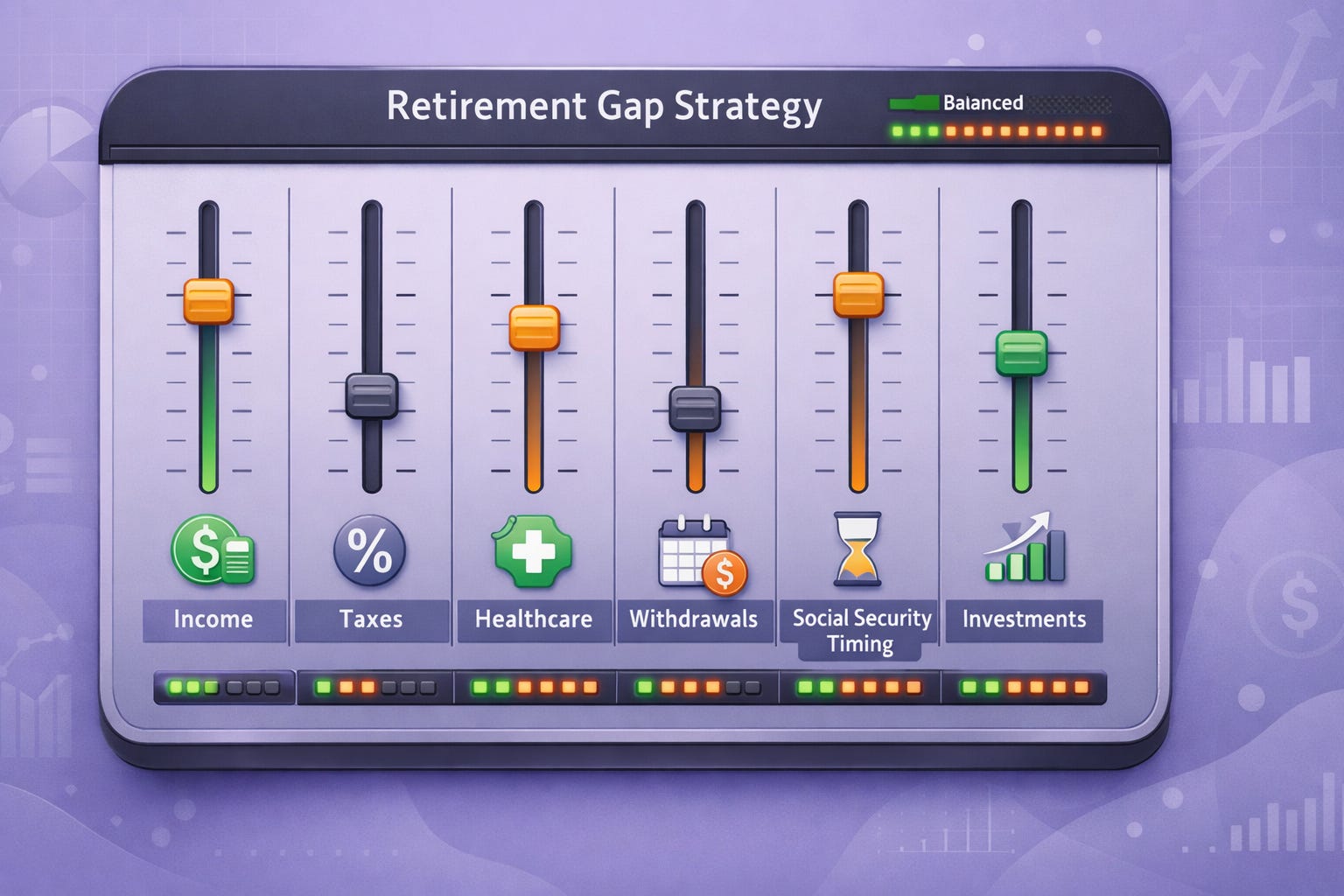
For many early retirees, the years between leaving the workforce and reaching key benefit milestones are the most financially challenging. You’ve stepped away from a paycheck, but you’re not yet eligible for Social Security, Medicare, or penalty-free retirement withdrawals from certain accounts. These “in-between years” — sometimes called the retirement gap — can last a decade or more.
If you approach them strategically, they can become a period of opportunity, not just financial stress. The goal is to bridge this gap without depleting the savings you’ll need for the decades ahead.
Step 1: Understand the Milestone Timetable
Before you can bridge the gap, you need a clear picture of when each benefit kicks in:
● Social Security — You can start collecting as early as 62, but benefits are permanently reduced if you claim before your full retirement age (FRA), which is between 66 and 67 depending on your birth year. Waiting until age 70 maximizes your monthly payout, which can be a significant boost over the course of your lifetime.
● Medicare — Eligibility begins at 65. Retiring earlier means you’ll need to find alternative health coverage for the gap years, and costs can be steep without planning.
● Penalty-Free IRA Access — You can take distributions from most retirement accounts without the 10% early withdrawal penalty once you’re 59½. However, there are exceptions like the “Rule of 55” that may allow earlier access.
● Required Minimum Distributions (RMDs) — Starting at age 73 for most retirees, these withdrawals are mandatory from traditional IRAs and 401(k)s, and they count as taxable income. Failing to take them can trigger severe IRS penalties.
Step 2: Determine Your Gap-Year Income Needs
Your bridge strategy starts with knowing exactly how much you need to live on before those benefits arrive.
● Begin with your current annual expenses and adjust for retirement lifestyle changes. For example, you might spend less on commuting but more on travel.
● Include major fixed costs such as mortgage or rent, property taxes, utilities, groceries, and insurance premiums.
● Don’t overlook healthcare expenses, which often rise in the gap years. Factor in both premiums and out-of-pocket costs.
● Add an allowance for taxes, since withdrawals from different accounts will affect your taxable income differently.
Once you know your annual figure, multiply it by the number of years until your first major benefit kicks in. This gives you a total bridge funding target.
Step 3: Build a Multi-Source Bridge Fund
A bridge fund should combine multiple income sources so you can control both cash flow and taxes.
● Taxable Brokerage Accounts — Investments in taxable accounts are accessible anytime without penalties, and long-term capital gains may be taxed at favorable rates. You can also structure withdrawals to stay under certain tax thresholds.
● Cash Savings & CDs — While returns may be modest, keeping a portion of your bridge fund in cash or certificates of deposit ensures you have stability and liquidity when markets are volatile.
● Roth IRA Contributions — You can withdraw contributions (but not earnings) from a Roth IRA at any time, tax- and penalty-free. This makes it a flexible backup source during unexpected expenses.
● Rule of 55 Access — If you leave your job in or after the year you turn 55, you can withdraw from that employer’s 401(k) without penalties, potentially reducing the need to dip into other assets early.
● 72(t) SEPP Withdrawals — These allow you to take equal periodic payments from an IRA before 59½ without penalties, but the rules are strict, and once started, you must continue for at least 5 years or until you reach 59½, whichever is longer.
● Part-Time or Consulting Work — Even modest income from consulting, freelance work, or a side business can dramatically reduce the amount you need to draw from investments.
● Rental Property Income — Owning a rental property can create steady income streams, though you’ll need to plan for vacancies and maintenance costs.
Step 4: Plan for Healthcare Before Medicare
Healthcare is often the biggest unknown cost in early retirement, and failing to plan for it can derail your budget.
● ACA Marketplace Plans — The Affordable Care Act marketplace offers private plans with subsidies based on taxable income. By managing withdrawals, you can potentially qualify for lower premiums.
● COBRA Coverage — Extends your employer health coverage for 18–36 months, but premiums can be high since you pay both your share and the employer’s portion.
● High-Deductible Health Plans + HSAs — A Health Savings Account allows pre-tax contributions, tax-free growth, and tax-free withdrawals for qualified medical expenses. Using an HSA in early retirement can provide a triple tax advantage.
● Healthcare Sharing Ministries — These are community-based cost-sharing arrangements, often less expensive than insurance, but they have coverage limitations and aren’t regulated like traditional plans.
Step 5: Optimize Withdrawals for Taxes
Your taxable income in the gap years may be lower than in your working years, creating opportunities to reduce lifetime taxes.
● Roth Conversions — Move money from a traditional IRA to a Roth IRA at a lower tax rate during low-income years. Once converted, the money grows tax-free, and withdrawals are tax-free in retirement.
● Capital Gains Harvesting — If your taxable income is below certain thresholds, you may be able to sell appreciated assets and pay little to no tax on the gains.
● Withdrawal Sequencing — Spend from taxable accounts first, then tax-deferred accounts, and finally Roth accounts. This preserves your most tax-advantaged savings for later years.
● Deferring Social Security — Every year you delay past full retirement age increases your benefit by roughly 8% until age 70, boosting lifetime income and inflation-adjusted security.
Step 6: Manage Sequence of Returns Risk
Early market losses can permanently damage your retirement portfolio — a phenomenon called sequence of returns risk.
● Keep 2–3 years of living expenses in cash or low-risk assets so you don’t have to sell investments in a downturn.
● Maintain a diversified portfolio that balances growth with stability.
● Consider using a “bucket strategy” — short-term needs in cash, medium-term in bonds, and long-term growth in stocks.
Step 7: Review Annually and Adjust
Your bridge plan will evolve as markets shift and your personal situation changes.
● Revisit your spending annually to catch cost creep or new expenses.
● Monitor your tax bracket and adjust withdrawals to optimize tax efficiency.
● Stay alert for changes to Social Security, Medicare, or tax laws that may impact your timeline.
● Adjust investment allocations to maintain your risk comfort level as you approach benefit milestones.
Bottom Line
Bridging the gap between early retirement and your key benefit milestones isn’t just about having enough money — it’s about managing your resources in the smartest, most tax-efficient way possible. With the right combination of income sources, healthcare planning, and tax strategies, you can make these years some of the most financially rewarding and personally fulfilling of your retirement.